Austyn Taylor on Clay Optimism and the Animal Within.
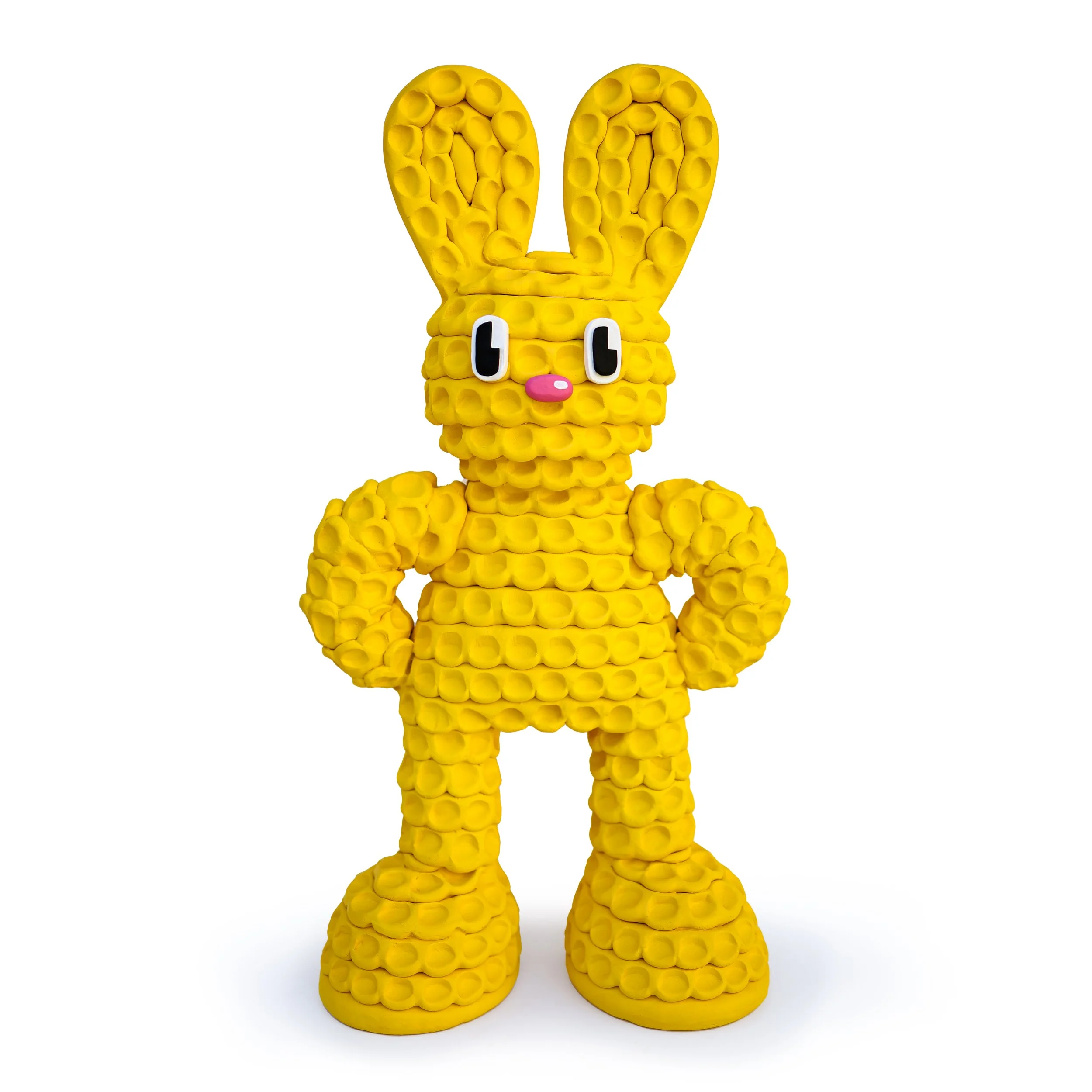
Sam I Am 2025 Stoneware&Pigment
Photo Austyn Taylor
INTRODUCTION
Austyn Taylor creates animals that appear to have wandered into our world carrying an important but slightly mysterious message. Bulls, horses, rabbits, birds and other creatures stand with vivid colour, strong silhouettes and an unmistakable sense of presence. They are funny, reassuring and sometimes absurd, but their optimism is never naïve.
Born in Rochester, New York, Taylor trained in illustration and art education before discovering clay while teaching middle-school students in Denver. That encounter changed the direction of her life. Residencies and exhibitions subsequently took her across the United States and to studios in Beijing, Copenhagen, Beirut, Mexico and elsewhere. She is now based among the coastal redwoods of Mendocino in Northern California.
Taylor’s contemporary ceramic sculptures draw from ancient animal forms, Mesoamerican ceramics, cartoons, video games, modern art and the behaviour of animals themselves. Beneath their accessible surfaces lies a serious question: how do we continue to care, play and make things in a universe that offers no guarantees?
In this conversation, Taylor speaks about living with wild animals, learning from her students, finding honesty in bright colour, surviving the risks of ceramics and her dream of bringing enormous animal sculptures into public space.
Interview by Olivier Varossieau
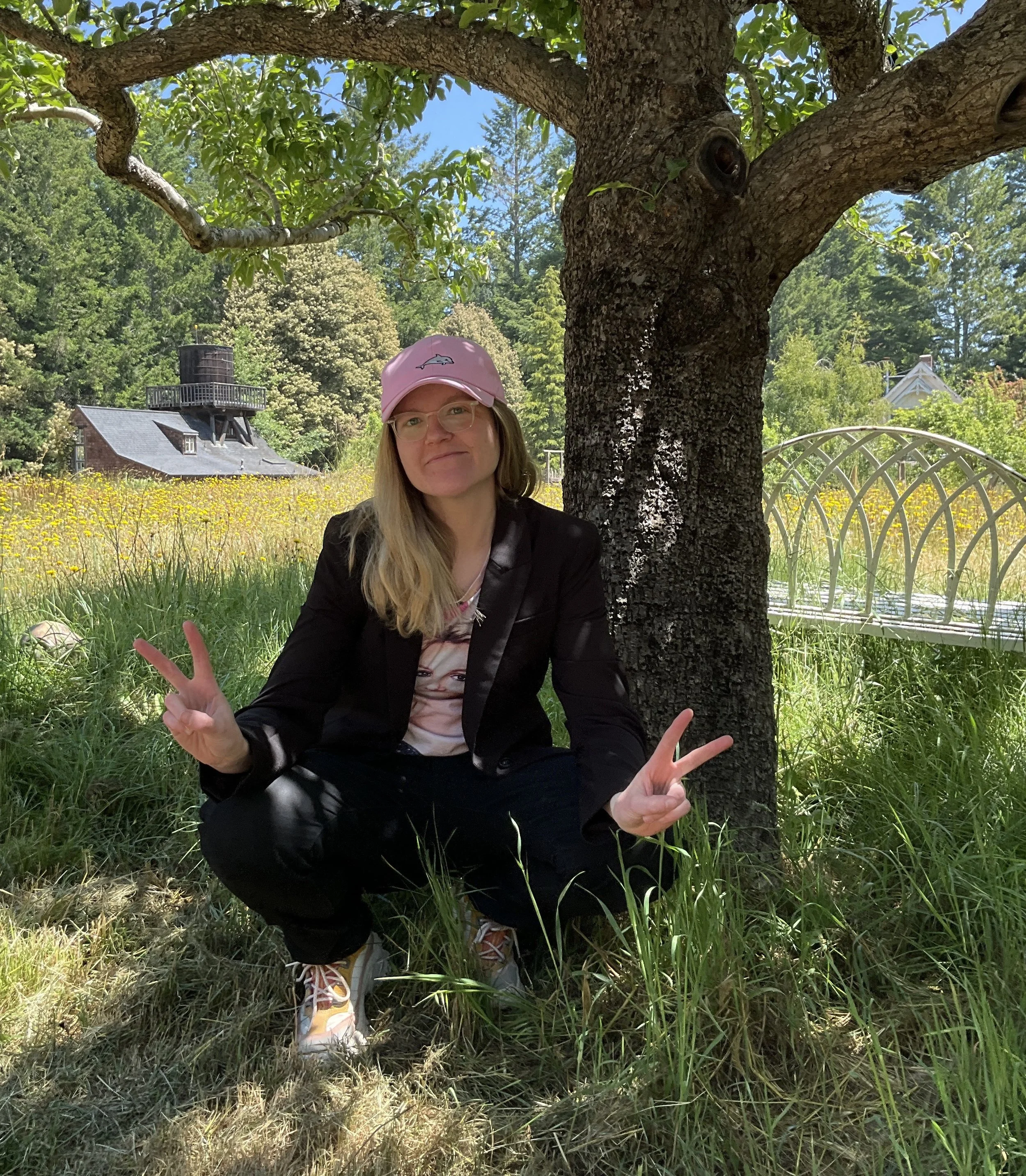
Austyn Taylor in the outdoors
THE INTERVIEW
You spent many years moving between countries, residencies and temporary studios. What did that nomadic life teach you?
The value of a friendly stranger is immeasurable. Wherever I travelled, being kind and gracious helped the story move forward. Living in so many places confirmed something I already suspected: human beings are the strangest things in the universe, and we are all in this absurd situation together.
Moving constantly also makes you very good at leaving. You learn to pack up and disappear at a moment’s notice. I value staying in one place much more now because it creates a completely different headspace, although I am probably still recovering from all that movement.
I finally have a home base instead of only having the road. My mind has not necessarily settled, and I still leave for residencies for weeks or months, but now there is somewhere to return to.
You live close to a protected park in Northern California. How have the animals around your home entered your thinking?
I am so guilty of anthropomorphising animals that I should probably be sent to prison for life.
One of my earliest memories of connecting with an animal is from Rochester. I must have been five. The neighbour’s dog was digging on one side of a chain-link fence, so I started digging on the other side.
I am still overwhelmed by how strange it is to be alive inside a body. The animals outside my home remind me how difficult it is to survive on Earth. There are cougars, coyotes, bears and eagles. There are viruses, rattlesnakes, hunger and dehydration. Yet the deer, quail and turkeys still find moments in which to frolic.
Play, silliness and catharsis are critical to survival. The animals remind me that we are them and they are us. We evolved together in the same arena.
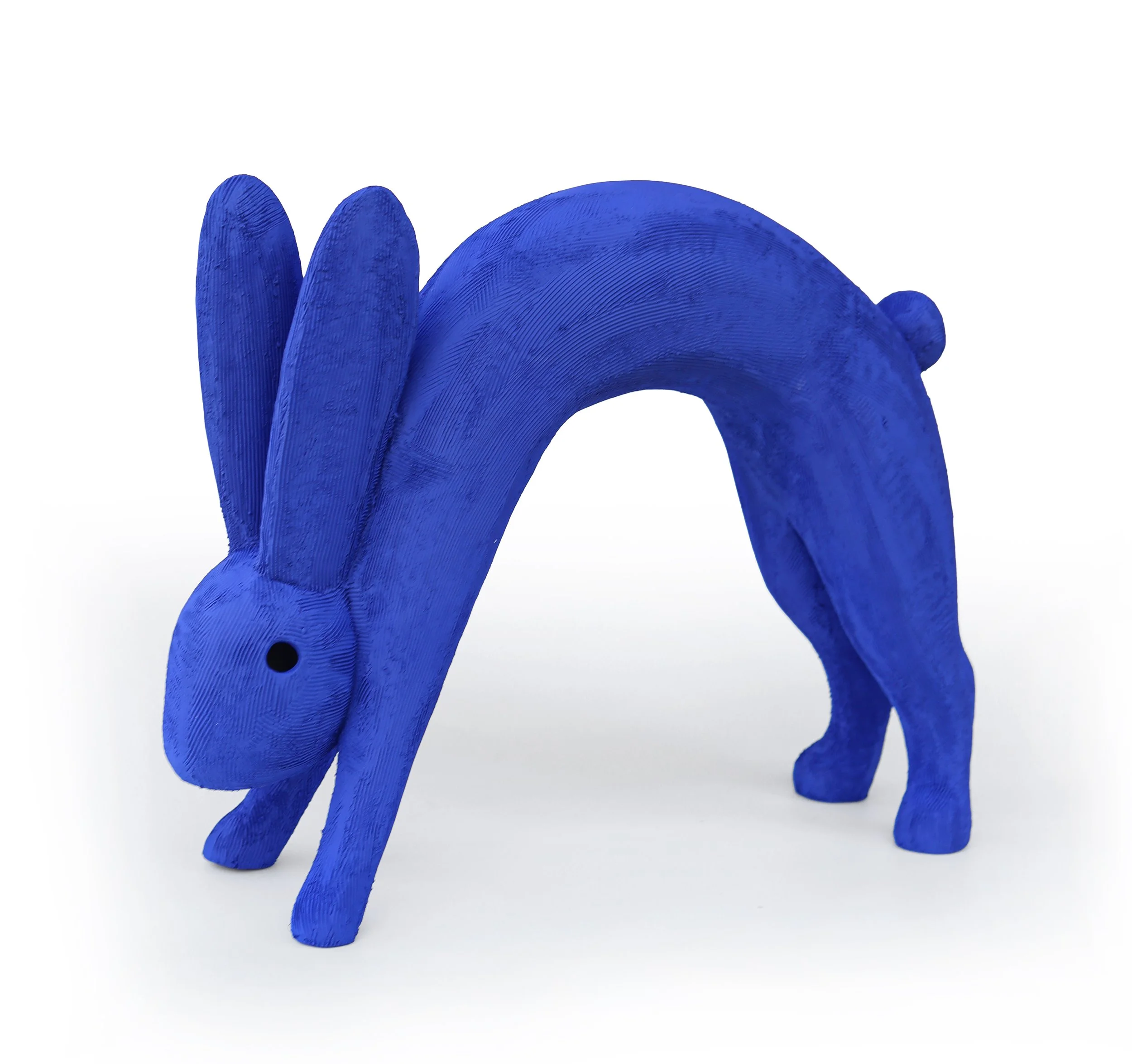
It’s a stretch 2025 Stoneware&Pigment
Photo Austyn Taylor
You knew from a young age that you wanted to become an artist. What did that mean to you then?
When I first became consciously aware of the world, the plan was “cowgirl and artist.” I arrived with an unrelenting need to make characters. I dreamed about animation and, later, video-game worlds.
In middle school I discovered Joseph Campbell and the hero’s journey: you leave, experience the world and return with something that might renew your culture. I genuinely believed that the world needed better art before peace could become thinkable. I have carried that idea with me ever since.
I originally studied illustration, philosophy and art education. For a while, I thought I would become the world’s best art teacher. I wanted every student to leave my classroom able to draw a little better, understand art history and recognise more creative possibilities in life.
How did teaching lead you to clay?
During my first year of teaching, I had to clear out an enormous collection of materials left by the previous art teacher. It took months. Eventually, I discovered an entire wall made from boxes of clay.
I learned ceramics while teaching it to my students. I prepared these huge, condensed art-history presentations to accompany every project. We moved from the Venus of Willendorf to Damien Hirst at an absurd speed because I wanted them to see everything.
The students kept telling me, “Ms Taylor, you should be an artist.” They were right, so I quit.
Something had immediately clicked with clay. I could not paint or draw my way into physical reality as directly as I could with clay. Even pulling it out of the bag brought instant clarity. It felt inevitable.
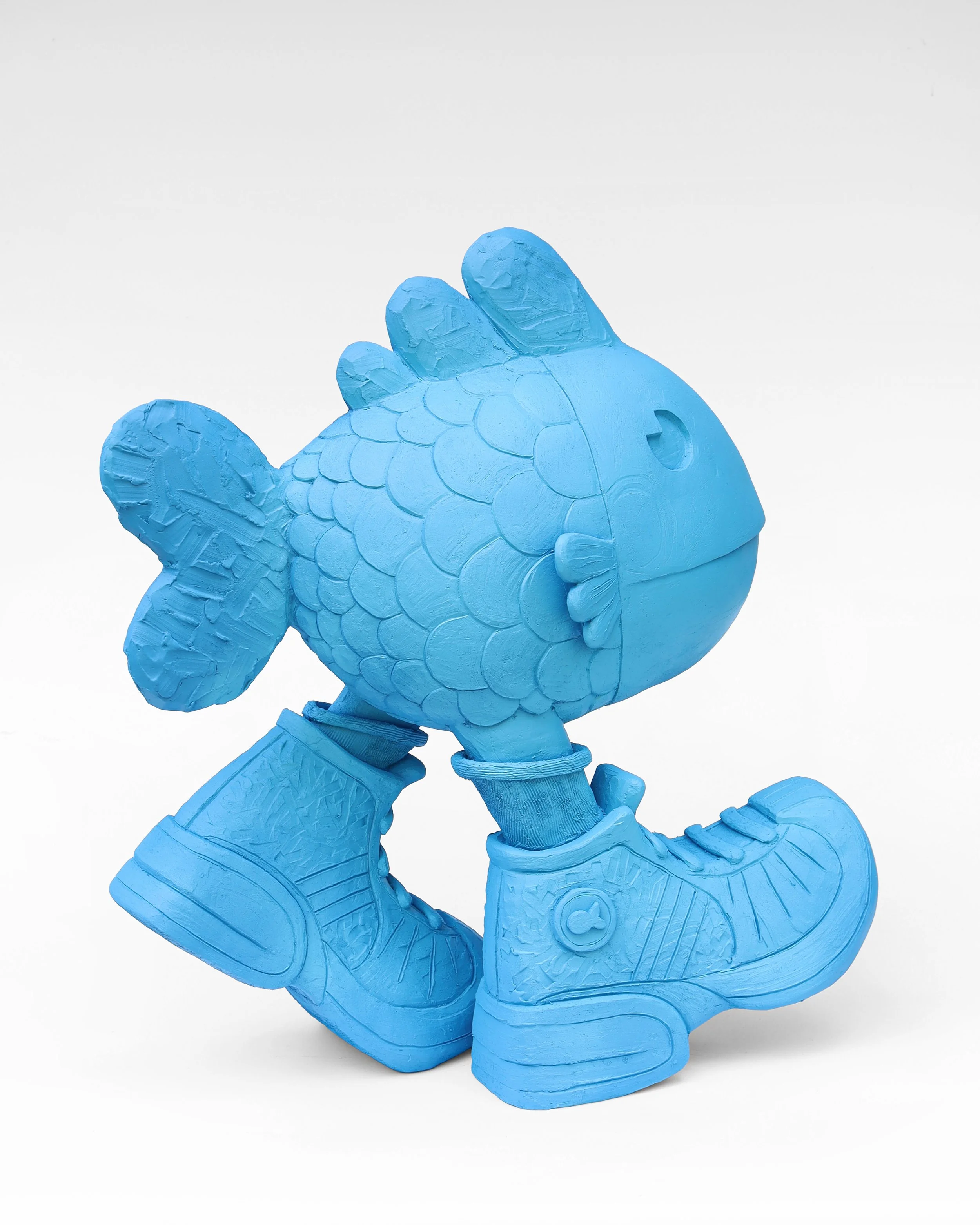
There Is No Such Thing As A Fish 2026 Stoneware&Pigment
Photo Austyn Taylor
What did your students teach you about creativity?
The first thing I learned was that the job involved helping to raise people’s children. Many of my students came from troubled homes. My real responsibility was to be a loving, intelligent “good guy” in what could be a frightening world.
Teaching middle school was like watching time move in reverse. It gave me many insights into how people struggle to become themselves. Being a person is not for the weak.
I also noticed that the clay object someone makes reveals an astonishing amount about them. I later saw the same thing while teaching privately, at colleges, in community centres and during workshops. The object tells you about the person. Perhaps someone could create a new psychological manual based entirely on clay forms. There is money on the table if anybody wants to try it.
Your father is an artist and taught glass for more than forty years. What did you inherit from him?
My father, Michael E. Taylor, took me to museums around the United States when I was probably too young to understand them. At that age, I understood Wile E. Coyote better.
What I did understand was that fine art liked to be secretive and sometimes a little gross. Museums in the 1990s contained a great deal of shock art. My father would point out what he considered good: strong weight, presence, silhouette and form, usually with a touch of ugliness.
The most technically perfect object was not necessarily the most powerful. A work could be technically accomplished and still need a flaw to make it human and present. I continue to look for those flaws in museums. They are like secret messages saying, “I am powerful, but I am human.”
We disagreed about cartoons. He detested cartoon imagery, while I loved it. That conflict probably helped me find my own place between serious art and popular visual culture.
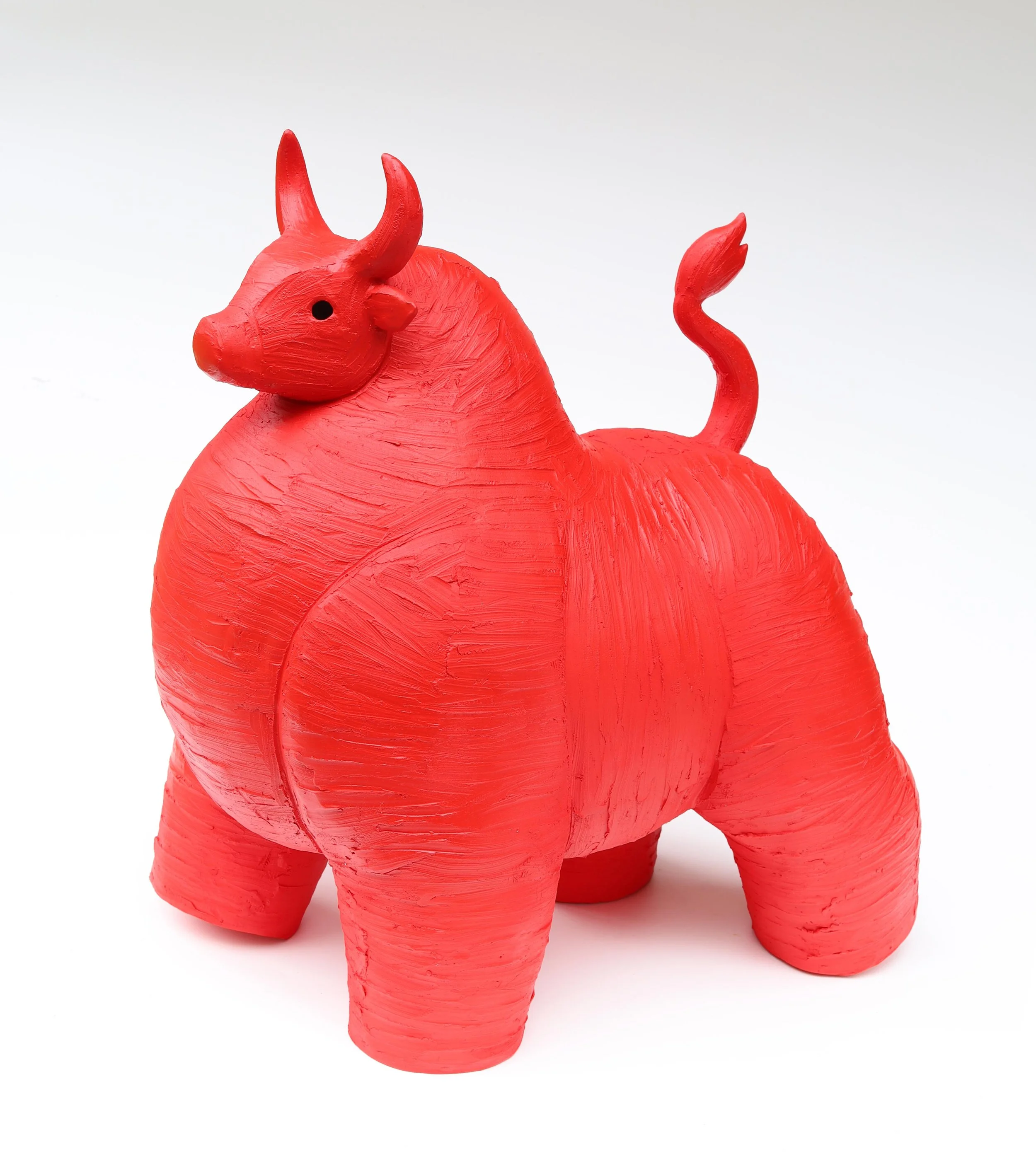
Lorenzo 2026 Stoneware&Pigment
Photo Austyn Taylor
What feels most urgent for you to make now?
My best work before I die.
For a long time, I made individual sculptures that were strong but separate. I am a fairly isolated person, and perhaps the work reflected that. Now I want to create compositions in which different elements work together.
Togetherness is the mission. I want the characters to begin interacting, building a larger scene or sharing a common world. I have not completely solved that yet, but it is the direction that feels most important.
You have described your work as a search for unconditional love within an indifferent universe. When did that become central to your practice?
I think I have naturally done it throughout my life. I drew to soothe myself. Then I drew at school and made friends through it. Now I sculpt, and somehow the world has agreed to cover my living expenses so I can continue making these characters.
The universe may be indifferent, but the human world is built through the stories we tell. Stories become human realities. Within that shared space, supposedly impossible things can happen.
It is extremely important to tell a helpful story. My sculptures are markers that say somebody cared. I existed, and I cared. They are monuments to giving a hoot. Caring leaves you vulnerable, but that vulnerability can make the world better for everyone.
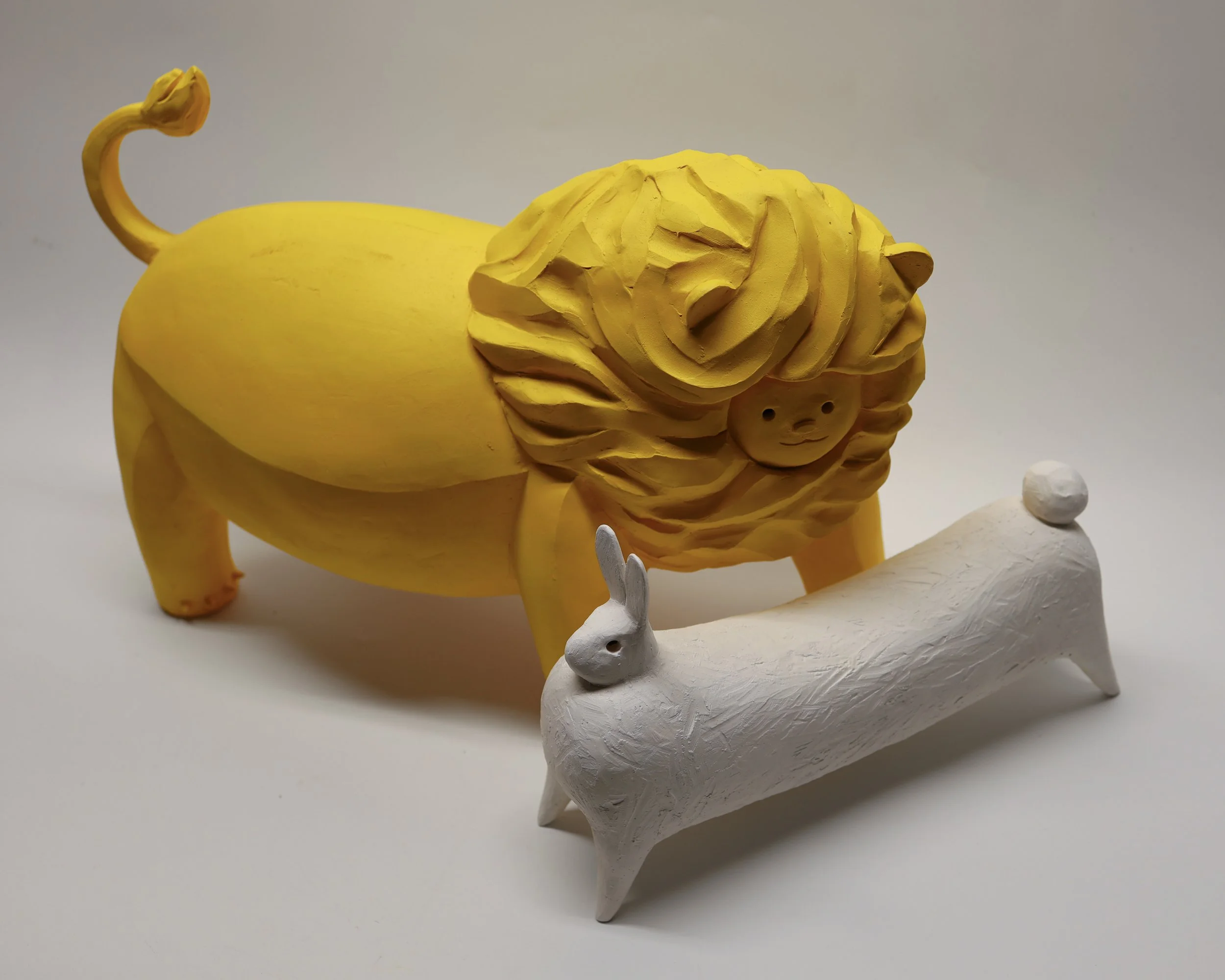
Oh No! Doesn’t Look Safe
GoodKing 2025 Stoneware&Pigment
Philip 2026 Stoneware&Pigment
Photo Austyn Taylor
Is optimism natural to you, or is it something you have to defend?
I do not find pessimism useful or particularly enjoyable. Cynical people sometimes remind me of ten-year-old students who can identify every crack but cannot build a structure.
Perhaps my optimism comes partly from my parents and their entrepreneurial Southern spirit. There was no boss who would arrive and repair the world. You accepted responsibility and tried to put something right.
Reality can be a tragedy or a comedy, but it is not a joke. You have to look into the abyss and push back against it.
Making sincere and hopeful work can feel radical in a culture that rewards irony and conflict. We spent decades wallowing in darkness and shock. I am not convinced it helped. Life may be a very slow boat in the middle of a vast ocean, but we can keep the fire going and help push it forward, even if we do not live to see where it arrives.
When a new character appears, what comes first?
I do not really see the sculptures as separate personalities. They feel more like incarnations of the same consciousness: the same clay and the same soul moving through a thousand different bodies. A very slow clay animation.
Sometimes I concentrate on “horseness,” “bullness” or “rabbitness,” but there can be a hundred possible versions of each. I have to choose one.
The sculpture must hold power. It needs to work from a distance, so silhouette is essential. Colour usually comes last. Underneath the different shapes, the characters are all saying something similar: “I exist. I am strong. I do not know what is happening. Oh, hello, another existing thing.”
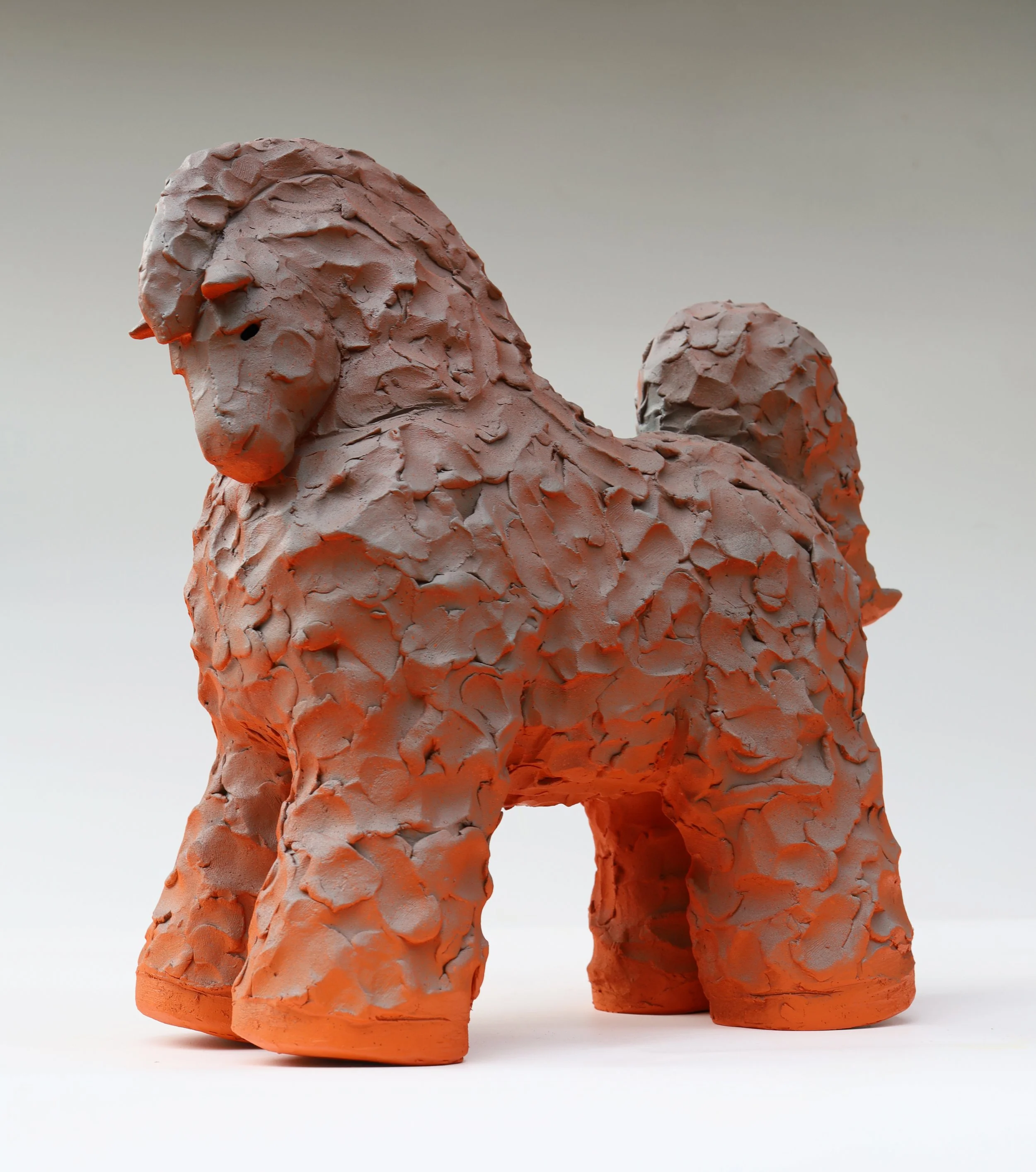
WillPower 2026 Stoneware&Pigment
Photo Austyn Taylor
Your influences range from ancient sculpture to Looney Tunes. How do these worlds come together?
It is largely subconscious. I study images, and later I find them again in sketches or in the clay. It is like recognising a pattern in chaos.
Looney Tunes probably has an unfairly large influence because I brainwashed myself with it as a child. At the same time, I am fascinated by the way ancient cultures represented bulls. Mesopotamian, Persian, Greek and Roman artists, as well as the people who painted at Lascaux, exaggerated the body in remarkably powerful ways.
Mesoamerican ceramic animals are another important influence. The Denver Art Museum has a collection of Costa Rican animal sculptures that once belonged to Walt Disney. Some of their shapes feel startlingly close to Donald Duck or Mickey Mouse.
Powerful forms keep finding artists who will make and remake them. That continuity is important to me. I am convinced that humans learned how to be human partly by watching animals.
How do you know when a sculpture has become alive?
It makes me laugh.
Suddenly, there is this ridiculous thing standing in front of you, inside your ridiculous life. When that happens, I feel immense gratitude.
The soul arrives first. The technical finishing comes afterwards. A sculpture can be technically complete and still feel empty, but if its presence is there, you know immediately.
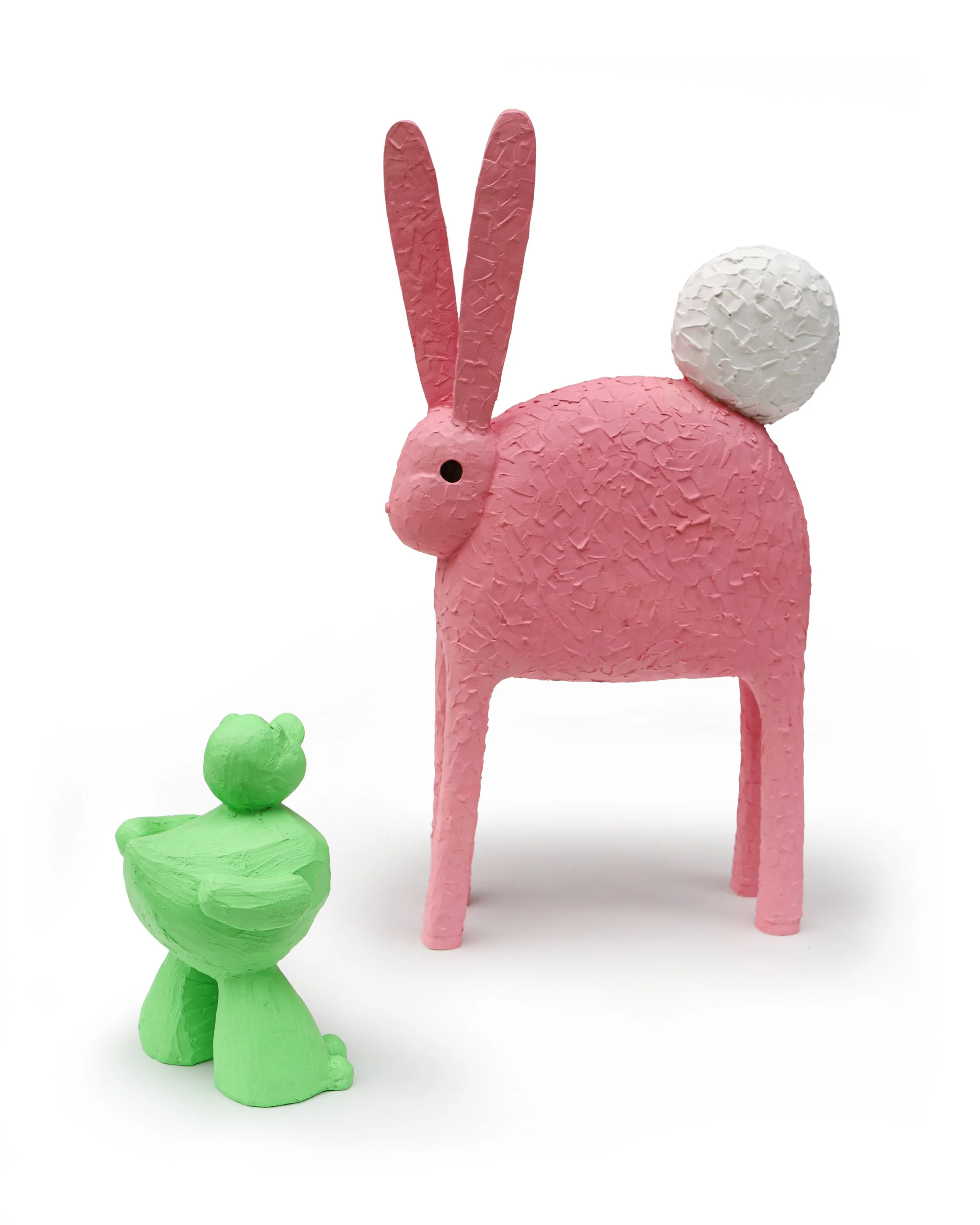
Are You My Mother?
Hopper 2026 Stoneware&Pigment
LuckyDuck 2024 Stoneware&Pigment
Photo Austyn Taylor
Your sculptures often use bright, direct colours and matte surfaces. What do these choices contribute?
Bright colour carries confidence. It can even be intimidating. Choosing to live in colour means asserting your existence, standing out and accepting that you will be visible. I am especially drawn to primary colours because they feel honest.
The forms are made according to my own invented rules and then covered with a layer of very human intensity. I want them to assert themselves.
I spent a long time experimenting with traditional ceramic glazes, but I did not arrive at sculpture through pottery. The form demands most of my attention, and I do not want the surface to distract from it. Matte finishes allow the silhouette and volume to remain in control.
I am not interested in technical difficulty for its own sake. I want to make the forms I need to make in as few steps as possible, so the sculpture remains the star rather than the technique.
Ceramics involves considerable risk. How has failure shaped your practice?
There are mountains of failure behind work that may appear simple.
I have made large sculptures that broke just before reaching the kiln, while being loaded, during firing or immediately afterwards. In graduate school, I tested hundreds of glaze formulas, blew up countless pieces and fired porcelain until it bent.
Ceramics can feel like a Sisyphus situation. You keep pushing the stone up the hill.
After many years, I have also learned to appreciate technical limits. They give you a defined space in which to think. Clay can offer a dozen possible directions at once, which is overwhelming. A limitation creates the boundaries of the sandbox.
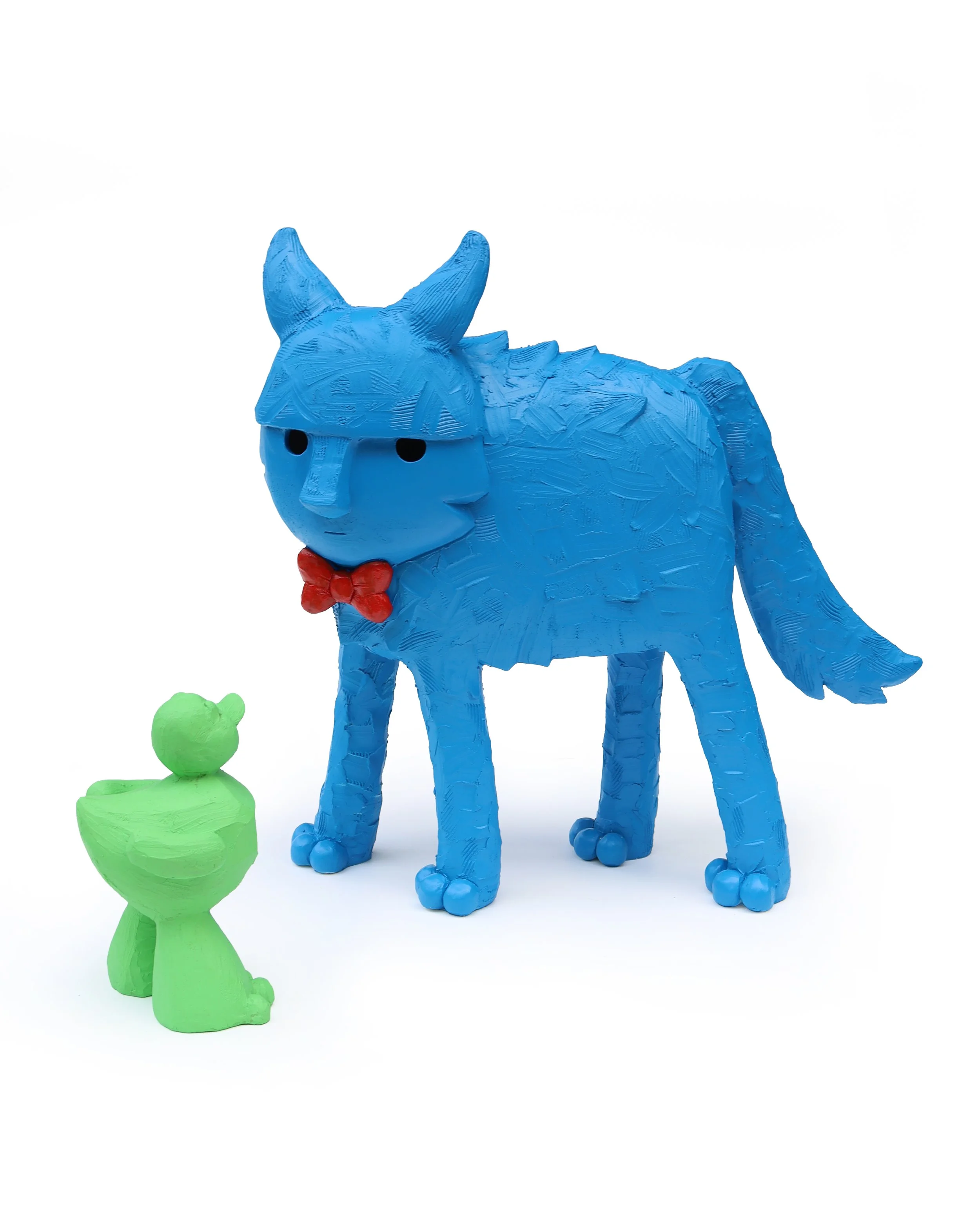
Are You My Mother?
BusinessWolf 2026 Stoneware&Pigment
LuckyDuck 2024 Stoneware&Pigment
Photo Austyn Taylor
You have spoken about making monumental public sculptures. What would happen if one of your characters became twenty-five feet tall?
I would like people to have a picnic in its shade.
I imagine the sculptures surviving for centuries and watching the future arrive, whether it turns out to be a utopia or a dystopia. People should be able to walk around them, sit nearby or perhaps even move underneath them.
Public art often becomes either an obstacle or something so carefully controlled that nobody can truly engage with it. I would like to find a happy medium: an artwork with real presence that remains generous to the people around it.
I imagine an enormous round red bull near Wall Street, a fat yellow bird looking up at the Statue of Liberty or a rabbit facing the Pacific near the Golden Gate Bridge. Commercial spaces, transport zones and financial districts could all use a twenty-foot rabbit or a stack of birds.
These sculptures would remind us that, if we are lucky, we have about eighty years. What are we doing with them?
Would clay remain essential at that scale?
My loyalty is to form, not to clay.
Clay is highly agreeable and has an extraordinary history, but I would happily translate the work into bronze, stone, concrete or another material. Monumental ceramics can be made, but they require serious engineering, especially in harsh climates.
The material should serve the character and the place. I would love to see the work in stone or marble and to explore bronze more deeply.
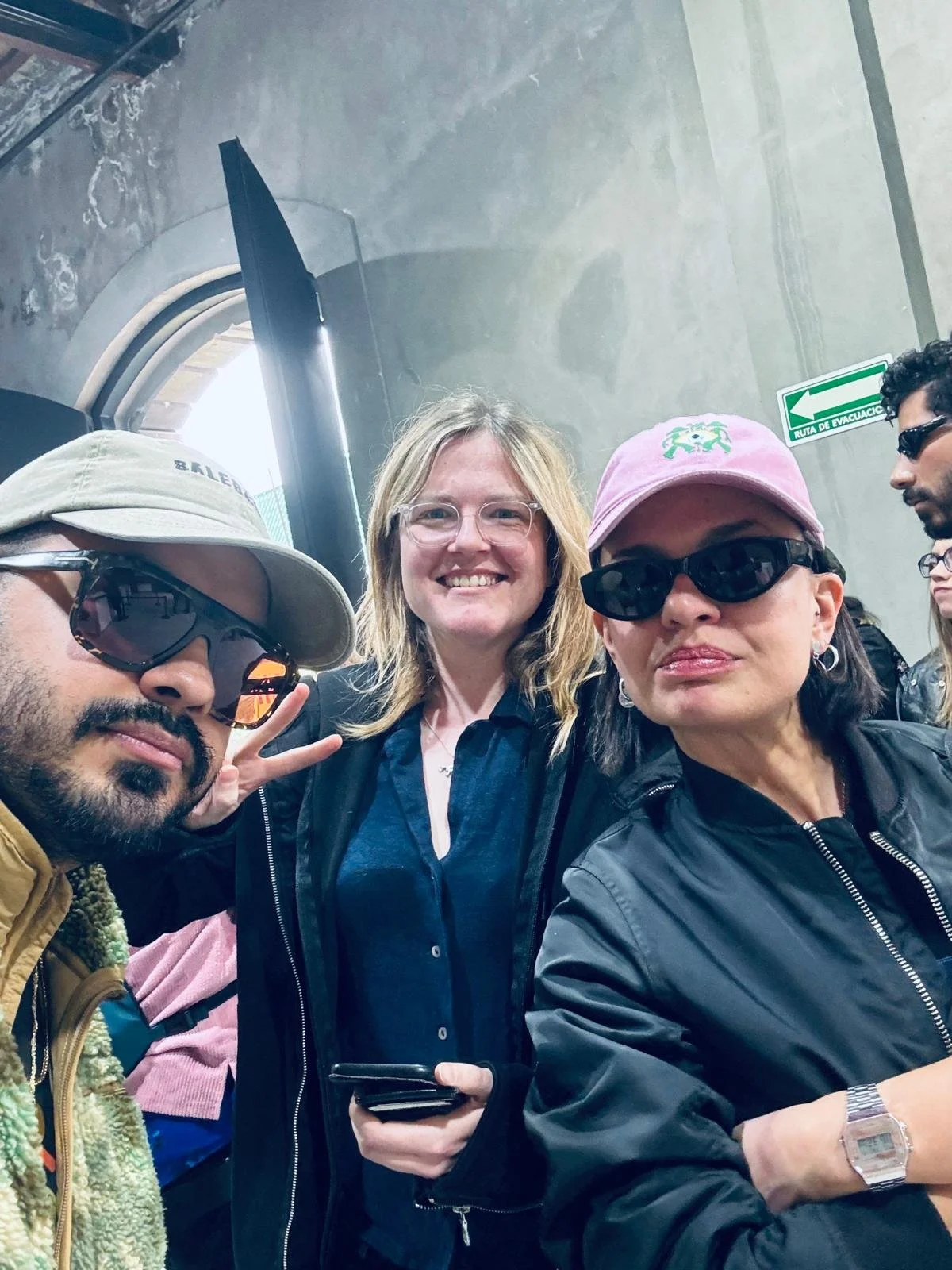
Jordi Alós, Austyn Taylor and Ginevra Russo in Mexico.
What did your residency at Cerámica Suro in Guadalajara give you?
Cerámica Suro is an enormous and highly sophisticated tile factory. The experience was less about traditional ceramic history and more about working inside a world-class production environment.
I was preparing works for exhibitions and commissions in Tokyo, Jakarta and Singapore, so I worked with great intensity. The atmosphere reminded me of graduate school. After spending years in extreme isolation in the redwoods, it felt wonderful to see other artists working with the same level of dedication.
From the outside, artists must appear completely crazy. We live and work inside a state of deadly serious fantasy.
Mexico also offered warmth, kindness and community. Meeting, eating and living with other artists was genuinely life-affirming. My studio life has often been solitary, so even a brief experience of artistic community meant a great deal.
More recently, you have become deeply interested in freshwater fish. What attracted you to that world?
My mother had a fish tank when I was young, and I used to dream about aquarium shops with rows and rows of tanks. Years later, in Beijing, I entered a sprawling basement filled with independent pet shops that looked almost exactly like those dreams.
For a long time, I hardly thought about fish. Then I began watching aquascaping videos to relax before bed. My boyfriend already had a large aquarium, so I started researching fishkeeping. It snowballed, and eventually I created FreshwaterFishkeeping.com because the available information was disorganised and often contradictory.
I may still have a teacher’s brain. When I learn something, I want to organise it and make it useful for other people.
Fish also return me to the central fact that humans are animals. A well-maintained aquarium can function almost like a memento mori. It reminds us that we are living bodies inside an ecosystem and not separate from nature.
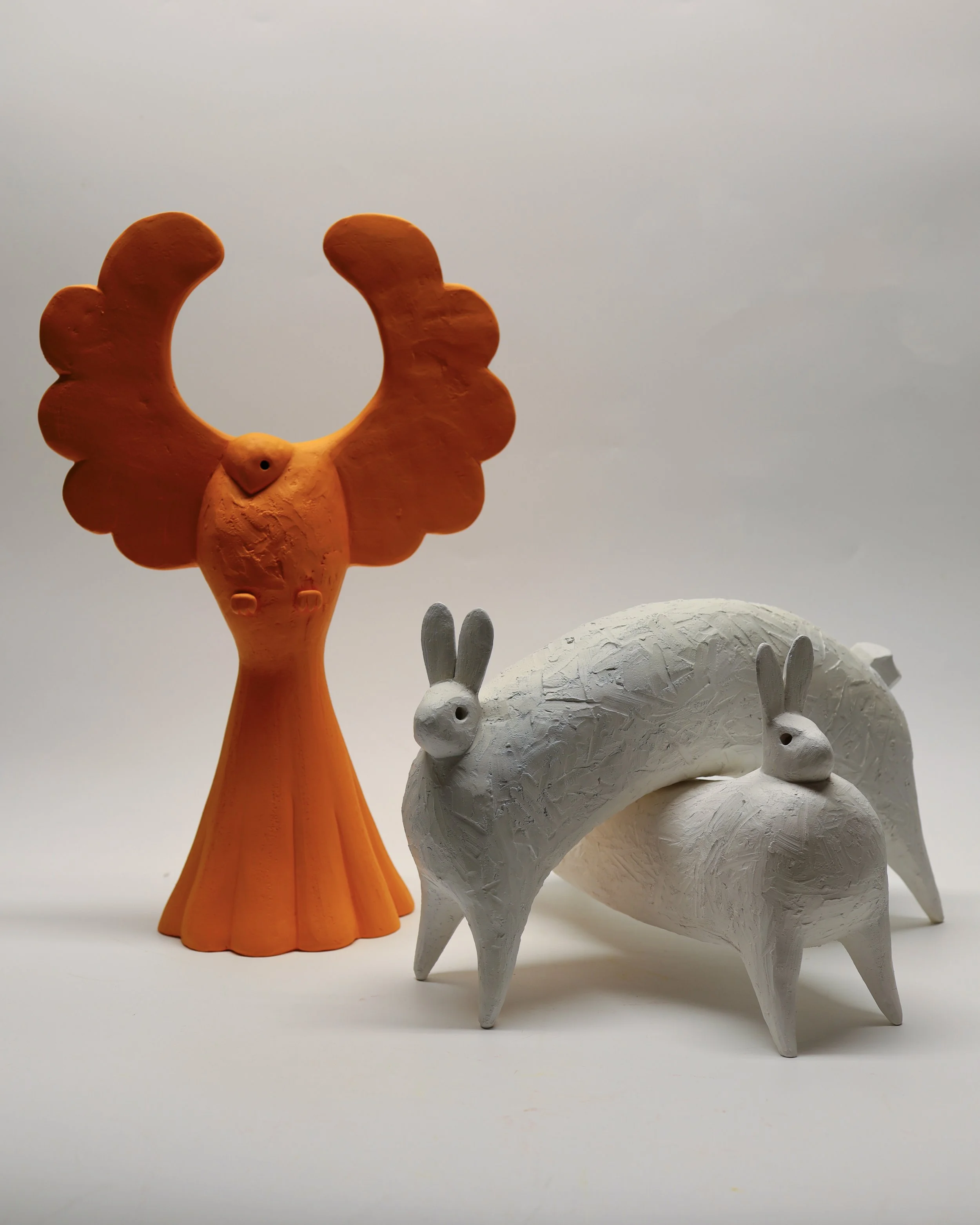
Technical Hurdle
Champion 2026 Stoneware&Pigment
Waffles 2026 Stoneware&Pigment
Philip 2026 Stoneware&Pigment
Photo Austyn Taylor
You have travelled and worked in many different cultures. What makes an artist residency a genuine exchange?
You make friends.
A residency becomes meaningful when the world feels a little smaller and friendlier afterwards. Meeting different kinds of people creates the exchange. The location alone is not enough.
I try to arrive smiling, warm, calm and ready to learn. You observe what is happening and match the atmosphere rather than arriving with a fixed plan.
For ceramic work, practical support matters too. Six weeks is about the minimum time needed to make substantial work and begin to understand where you have landed. You need tables, clay and reliable access to a kiln. Local knowledge and introductions are enormously helpful.
A residency is rarely the conclusion of a relationship with a place. Ideally, it is the beginning of a connection that continues for the rest of your life.
Would Bali interest you as a place to work?
Absolutely. I would never say no to a residency.
My first awareness of Bali came through my father and stepmother, who brought home carved Garuda figures and a Garuda kite when I was about nine. I remember the intense, almost psychedelic beauty of those objects.
I would not want to arrive claiming to understand Bali. I would need time with local artists and craftspeople and a genuine immersion in the cultural context. I would be fascinated to meet Balinese ceramicists, sculptors, painters, carvers and foundries. I would especially like to see those carved feathers and scales taking shape in real time.
If the animals or mythological creatures wanted to make their presence known, I am sure I would hear from them.
An open studio or exhibition would be a natural conclusion to a first residency. With a better understanding of the place, a later visit might lead to a public sculpture, workshop or community project.
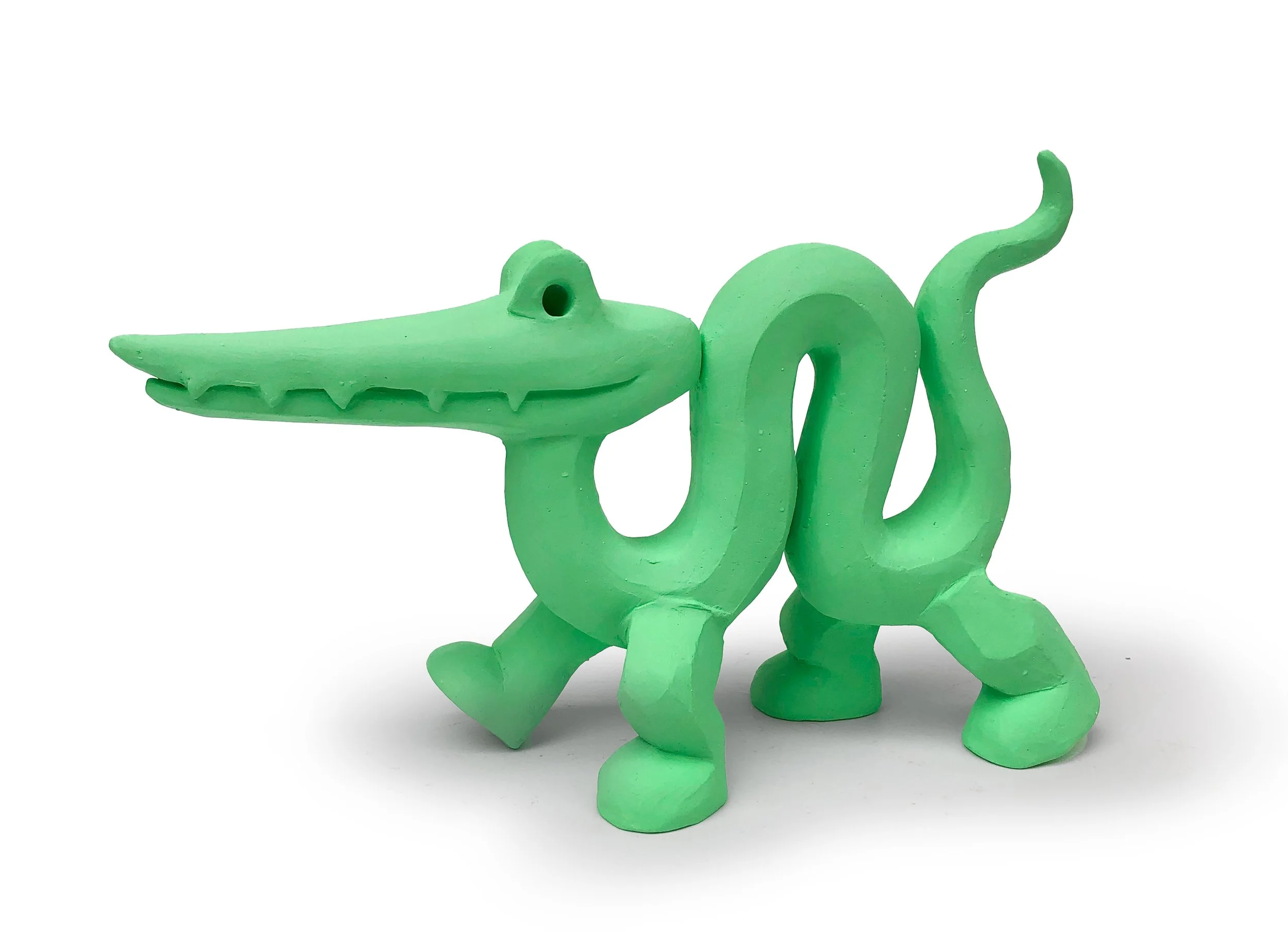
All's Fair In Love And War(Steven) 2025 Stoneware&Pigment
Photo Austyn Taylor
What happens when your sculptures leave the studio and enter private collections?
It can feel like sending satellites into space. I do not always know exactly where they land.
I once visited a collector’s home in Beirut. It was extraordinarily imaginative and beautifully designed. My sculptures had been placed as though I had made them specifically for those rooms.
That was a surreal moment. It felt as though I had been working subconsciously with artists and designers I had never met. This is what I love about our species: we can make remarkable things together.
The universe may be indifferent and cold, but our human world does not have to be. We have art, objects, rooms and the stories we tell each other.
Your work is now collected internationally. How has your definition of success changed?
I have succeeded in sustaining a life of sculpting. I am genuinely delighted that I managed to make that work.
I once dreamed of exhibiting in every major world city, and the work has travelled widely. That creates a funny situation: I have an international presence, but it is not concentrated in one place. Perhaps the conventional strategy would have been to become very visible in a single major city.
Still, I have built ground beneath myself. I can now concentrate more fully on the work. The next step is to create series that belong in museums and public spaces.
I want to develop a large scene resembling a Shakespearean play or a Renaissance battle painting: a field of sculptures interacting, fighting or dancing, each with its own strength and experience. A frozen performance made from characters that finally exist together.
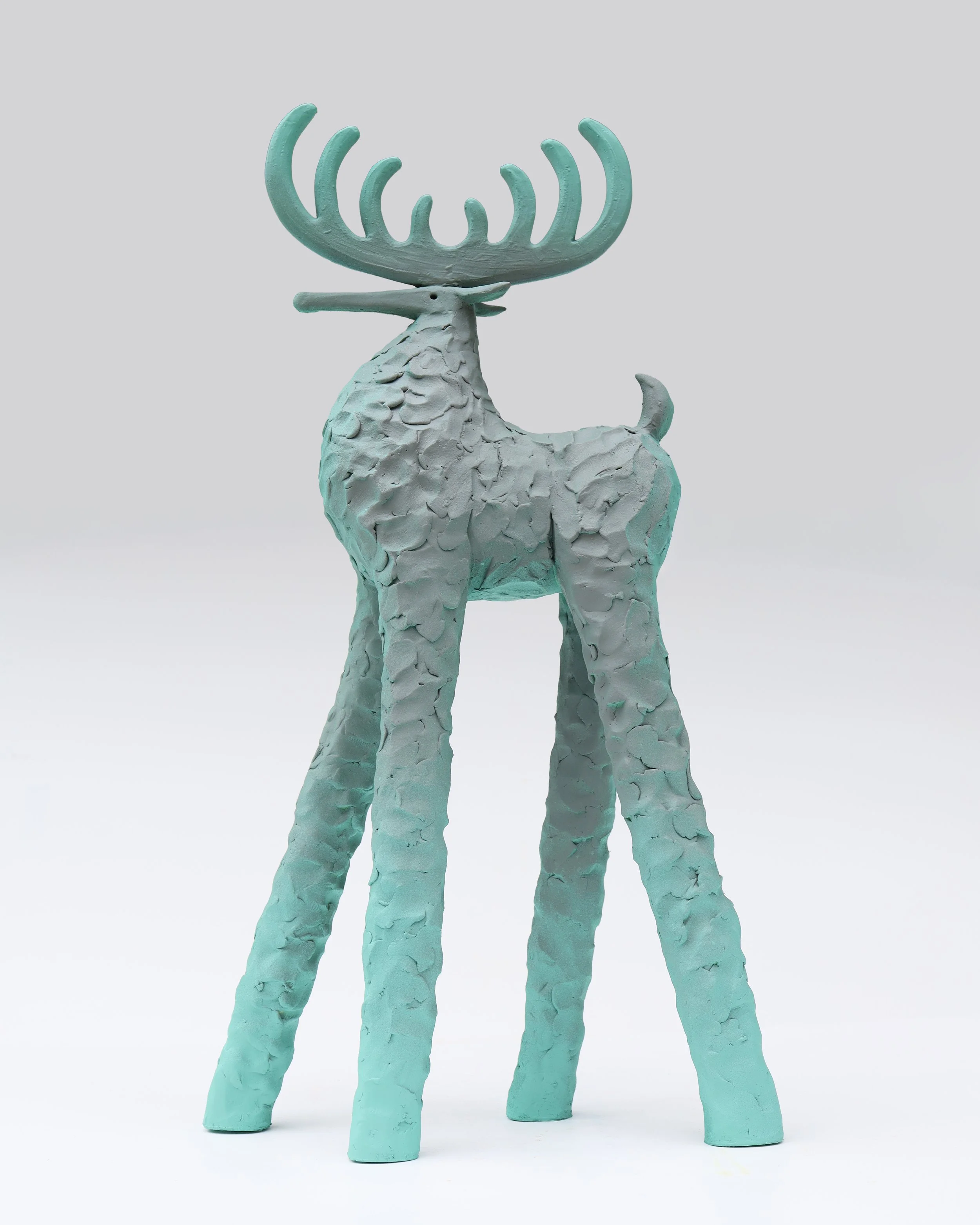
Confidence 2026 Stoneware&Pigment
Photo Austyn Taylor
After everything you have made and experienced, what are you most hopeful about?
We will be fine.
The human race has overcome extraordinary odds. We are still only beginning to understand what it means to live as a truly global society. The internet has forced everyone into the same room. It has exposed violence, injustice and all the skeletons people once kept hidden.
New generations will grow under these conditions and develop stronger minds. Humanity is not a species that gives up.
It is better to aim for the stars and land on the moon than to sit and stare at your socks.
Interview by Olivier Varossieau for Vroom & Varossieau.