Inge Cornil “When the Landscape Becomes the Painting”
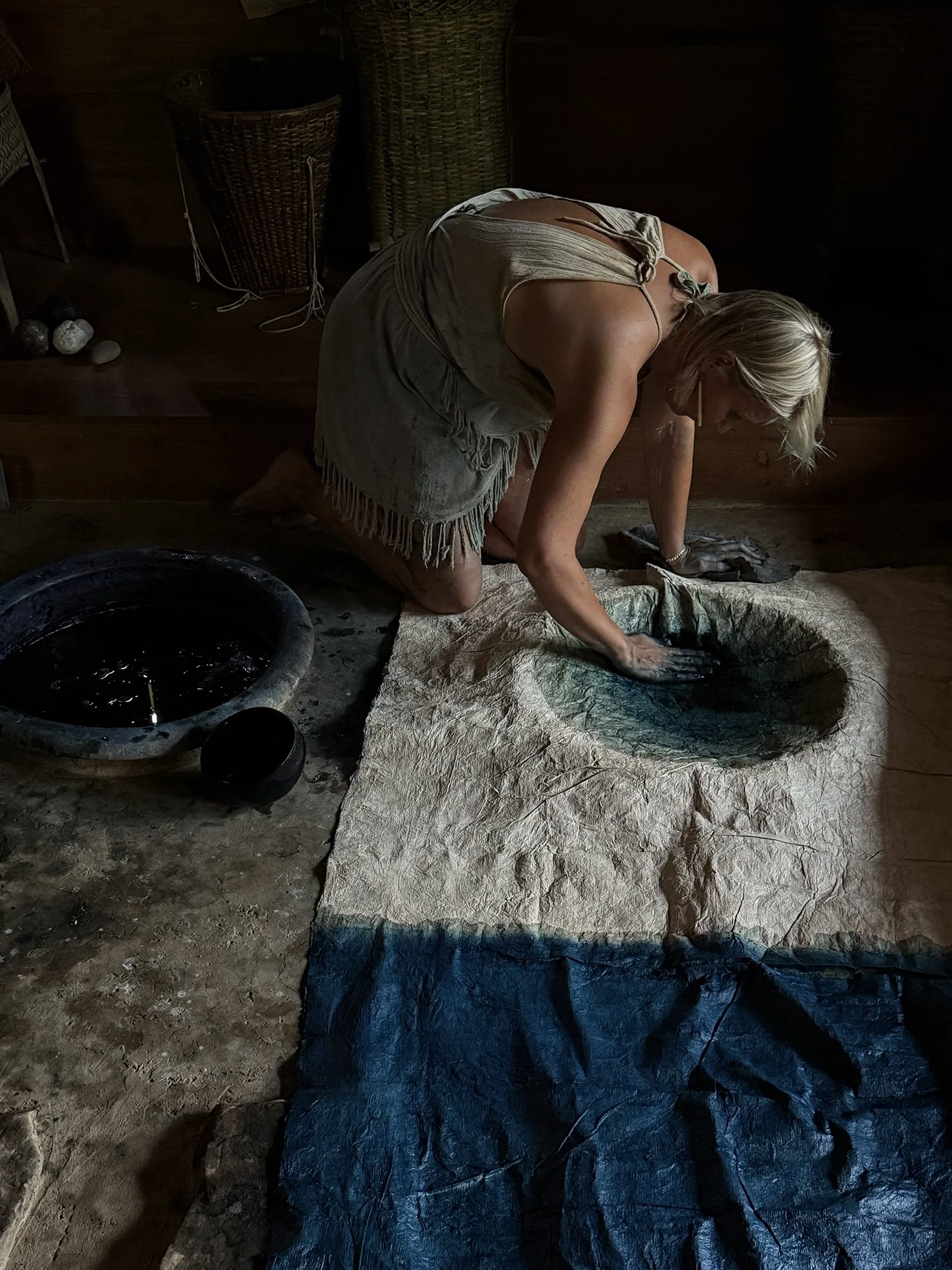
Inge Cornil at Pagi Motley the painting and dying process.
In conversation with Inge Cornil
Interview by Olivier Varossieau
Belgian artist Inge Cornil has always travelled in search of light. From Papua and Sumba to Tahiti and the remote Marquesas Islands, she has approached the landscape not simply as a subject, but as a place of observation, immersion and artistic research.
Her latest body of work, BARK WORKS, developed in Bali, marks a profound shift. Here, the landscape enters the work physically. Bark becomes canvas; indigo leaves, sappan wood, ketapang, mango and coconut become colour. Created through collaborations with the Balinese studios Tian Taru and Pagi Motley, the works unfold somewhere between painting and dyeing, artistic intention and natural transformation.
In this conversation, Cornil speaks about distant islands, the loss of her father, the mysterious force known in the Marquesas as le mana, and the moment she realised that she no longer wanted merely to paint the landscape, she wanted to allow the landscape to participate in the painting.
Olivier Varossieau: You have described the world as your “mobile studio.” When did travelling become such an essential part of your artistic practice?
Inge Cornil: I have always been fascinated by tropical light and by the idea of trying to capture something so intangible, changeable and immense. That kind of light cannot be understood from a distance. I need to observe it and experience it where it exists.
My love of travelling to distant continents began while I was studying for my Master in Fine Arts. One of my teachers took us to India, Cuba and Cape Verde. Those journeys opened something in me. I began to understand that travel could be more than inspiration; it could become part of the artistic method itself.
The world gradually became my mobile studio. Each place offers a different light, rhythm and material language.

Painting process at Pagi Motley
Olivier: Was colour already important to you before those journeys?
Inge: Colour has always been the protagonist in the way I interpret the world. Even as a child, I was fascinated by the dynamic relationship between light and colour. When I observe something, I instinctively begin making connections through colour.
All pigments originates somewhere in nature in stone, soil, bark, leaves or fruit. Each colour carries a different vibration. Emerald green has a completely different energy from ochre.
I am also fascinated by the journey a colour makes before it reveals itself. A green indigo leaf, for instance, passes through fermentation and oxidation before becoming a deep blue. The colour contains that entire transformation. It is never simply a colour.

Inge Cornil at Pagi Motley, the painting and dying process with the natural pigments.
Olivier: What happens to your senses when you arrive somewhere unfamiliar?
Inge: A new place gives me an enormous surge of sensory impulses. It reminds me of what David Hockney calls “the joy of seeing”. I become intensely conscious of looking, and that attention creates a wave of inspiration.
Travelling also allows me to let go of everyday life. It brings me into the present. Drawing and painting are ways of understanding reality more deeply. Through my hands, I try to feel the atmosphere, spatial depth and energy of what I am observing and then to hold that moment in matter.
It usually takes time to truly arrive. I may travel with a question or an initial curiosity, but I need to settle into a place before the artistic process can begin. Often, the decisive moment comes when nature becomes overwhelming. Silence and isolation bring me closer to the dialogue I want to create through observation, memory, imagination and atmosphere.
Olivier: Your work carries traces of an extraordinary geography: Papua, Sumba, Tahiti, Huahine, Moorea and the Marquesan Islands of Fatu Hiva, Ua Pou, Nuku Hiva and Hiva Oa. Why are you so drawn to islands?
Inge: The ocean has always played an important role in my life. As a child, I already felt an enormous freedom in the water.
An ocean creates distance between one piece of land and another. On an island, you can sometimes feel that you have temporarily disappeared from the rest of the world. I experienced that very strongly in Papua and the Marquesas.
Distance also alters your perception of time. During long crossings, urgency seems to fall away. A different kind of space appears as a space for imagination. It has made me realise that I want to live more closely according to the rhythm of nature. Stress often begins when that connection disappears.
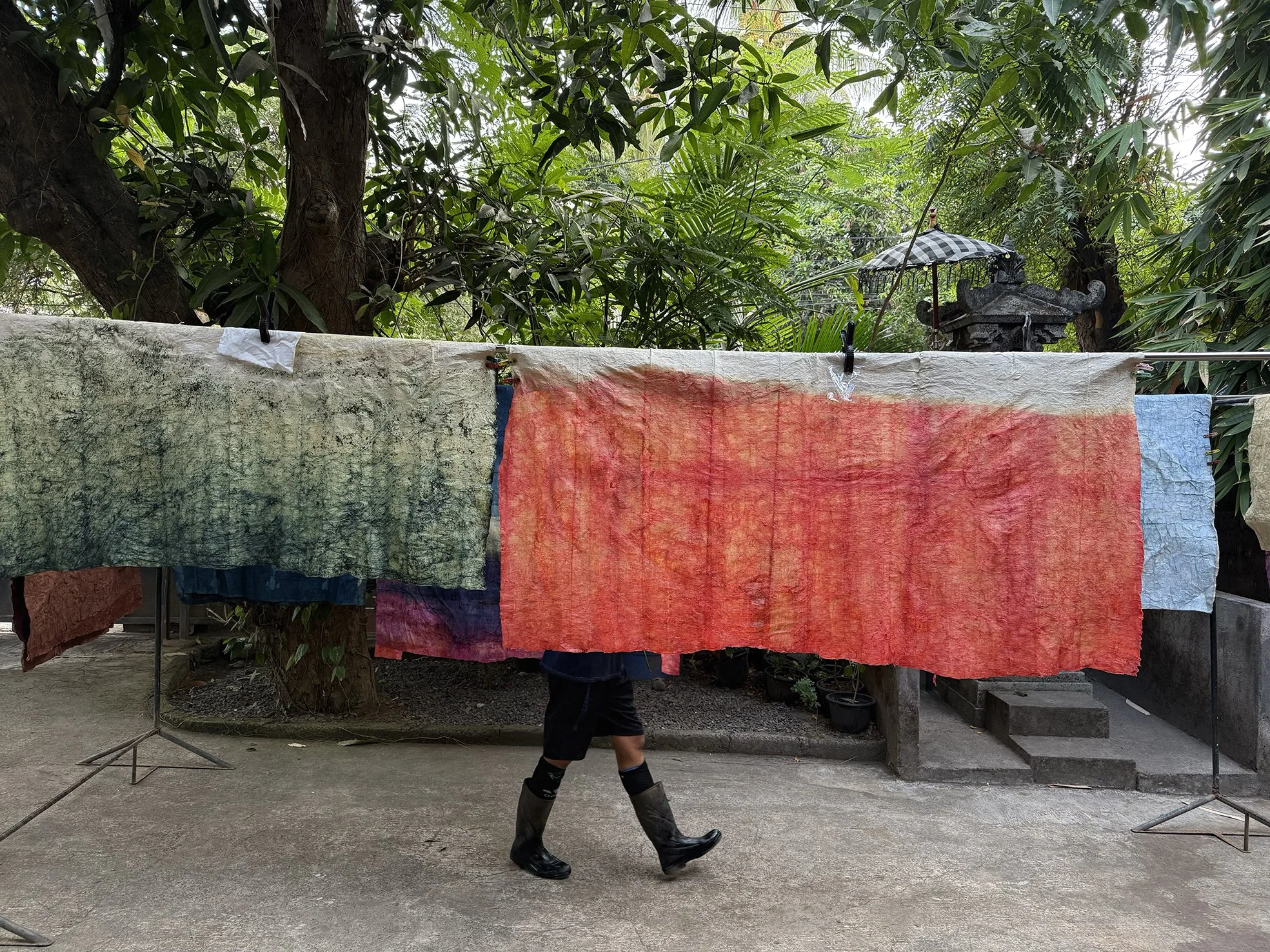
Painting and drying process by Inge Cornil
Olivier: Fatu Hiva is one of the most remote islands in the world. What did it take to reach it?
Inge: From Antwerp, I travelled by train to Paris, followed by a twenty-two-hour international journey to Tahiti. From there, I took a four-hour local flight to Hiva Oa and then spent another four and a half hours on a small fishing boat crossing the wild Pacific Ocean.
On a map, Fatu Hiva is little more than a pinprick between New Zealand and South America. To find yourself there, surrounded by the immensity of the ocean, does something to you as a human being.
I stayed with a local family of sculptors. Each morning, they drove my mobile studio in a pickup truck to an isolated place in the jungle, where I would paint until sunset. One evening, the roads had become so muddy that a tractor had to pull us out with all the paintings and working materials still with us.
These practical difficulties became part of the work. You cannot separate the image from the conditions in which it came into existence.
Olivier: During that journey, you also experienced an intensely personal moment connected to your father.
Inge: Yes. I was travelling on a small fishing boat between Hiva Oa, where Gauguin is buried, and Fatu Hiva, the island where he believed he had rediscovered le sauvage the wild.
My father was approaching the final moments of his life. At the exact moment he died, I experienced an immense energy rising out of the wild ocean and moving upwards into the atmosphere. I felt his passing.
I do not think I had ever felt so closely connected to him, even though, geographically, we could hardly have been farther apart.
I had travelled to Polynesia because I wanted to understand what Gauguin meant when he spoke of le sauvage. In the Marquesas, people speak of le mana: a powerful spiritual energy present in people, nature and the universe. During my period of mourning there, I was able to experience something of that force for myself.
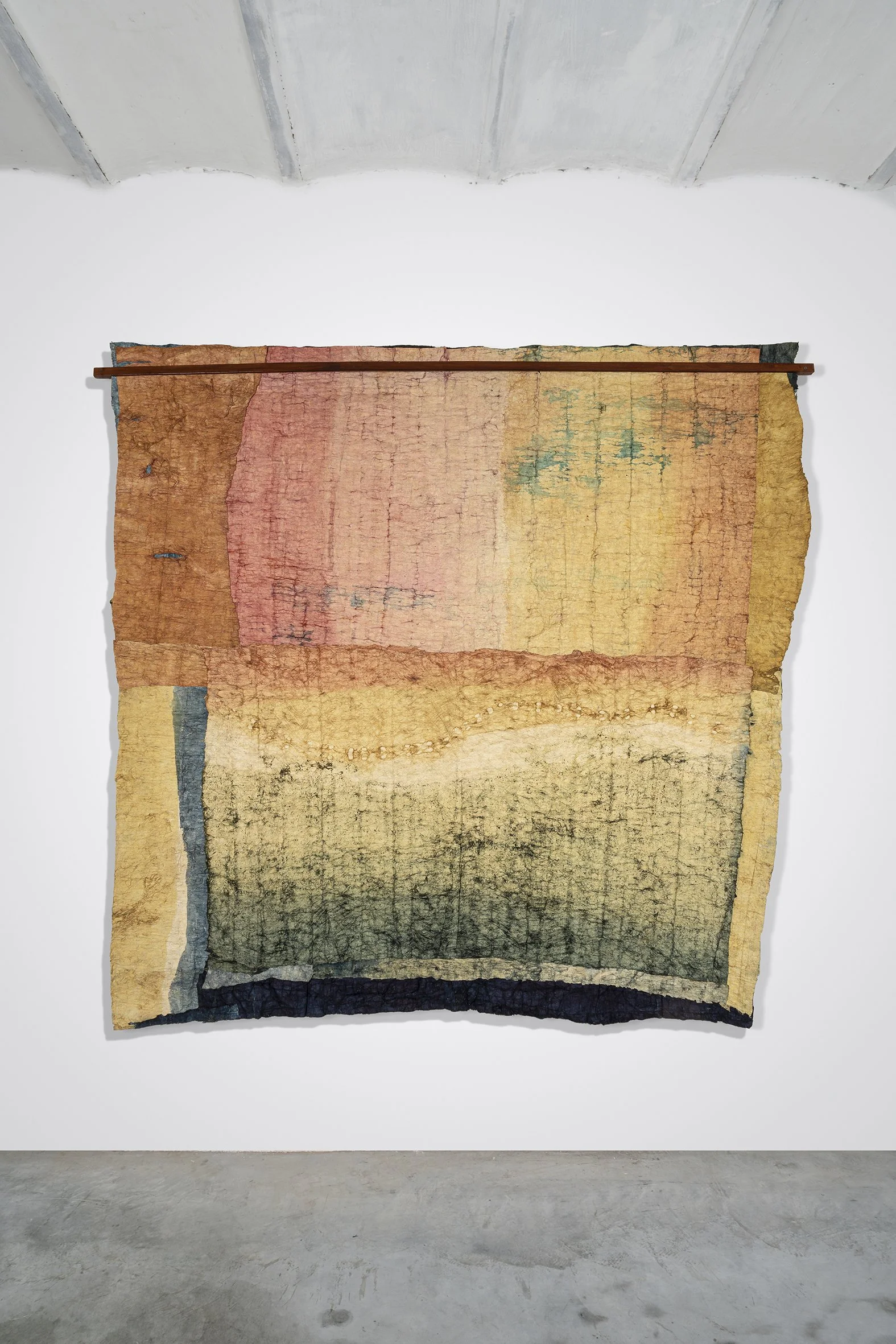
Bark works in the studio in Antwerp ±209×209cm
Olivier: When you return to Antwerp, how do these experiences become paintings?
Inge: The distance creates another perspective. Memories begin to reorganise themselves, and I inevitably look back from a Western context. That shift in position changes the work.
The process in my Antwerp studio is slower and more extended. A painting may consist of more than one hundred layers of pure pigment. Through those layers, I try to bring the tropical light back towards the surface.
My studio also allows me to work monumentally. Scale is important because I want the viewer to experience something of what I felt when I was physically surrounded by the landscape. The movement of my body during painting helps form the image, while the finished scale allows the viewer to enter its depth.
The titles often preserve a specific anecdote. Too Less Visibility, for example, refers to a small island in Papua during the rainy season. Visibility had almost completely disappeared, and we waited for hours on a deserted beach, hoping to see a dugong. The title does not recall the image, but the entire atmosphere surrounding it.
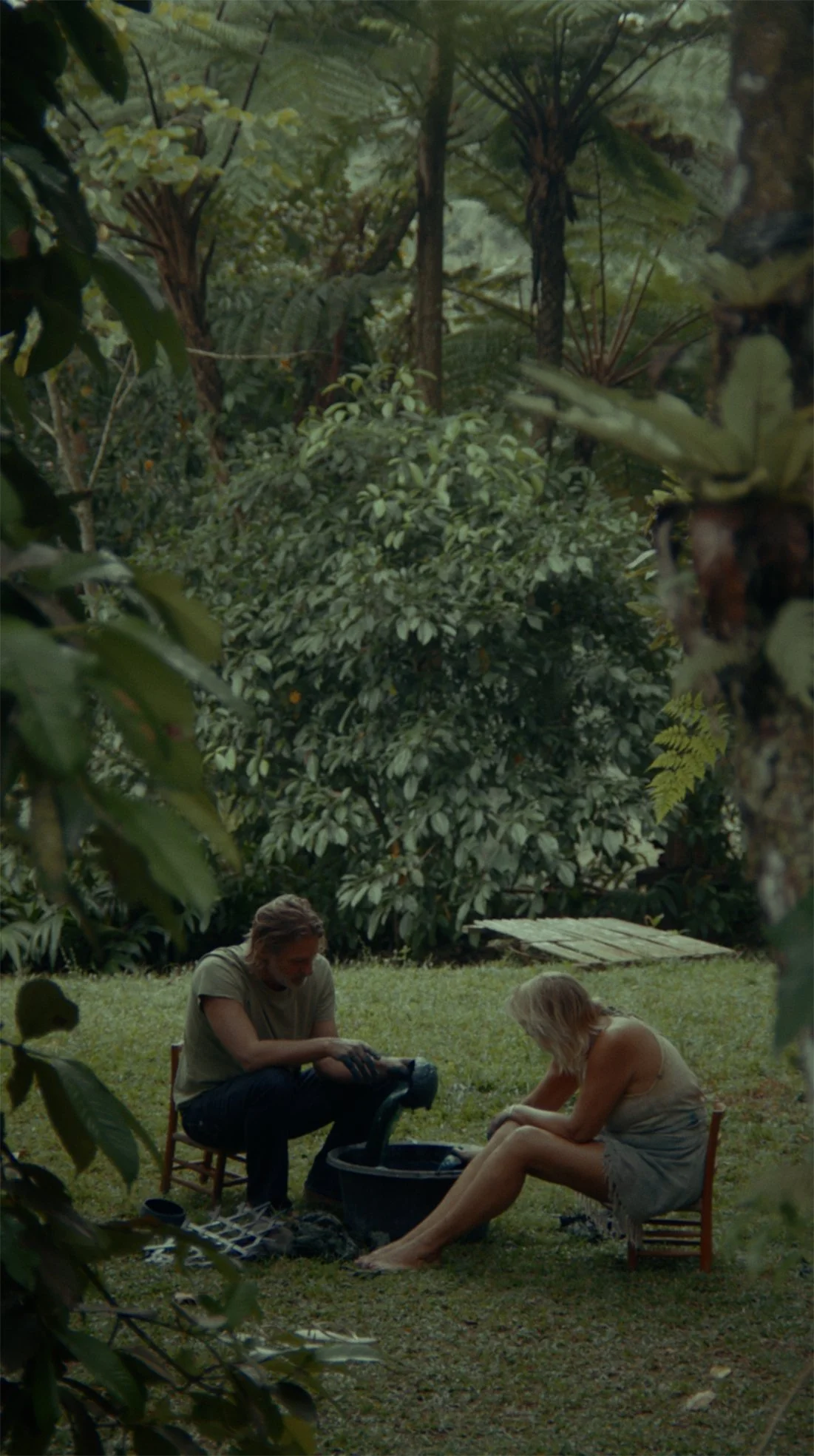
Inge Cornil coloring Indigo in a natural landscape at Tian Taru
Olivier: Your recent journey to Indonesia produced a major change in your practice. You have said, “I came to Indonesia to paint the landscape, but slowly the landscape began to change the way I paint.” What happened?
Inge: Bark cloth was a completely new material for me. I wanted to move beyond my comfort zone and test the limits of my own practice.
I had many years of experience as a painter, but the roughness and absorbency of bark cloth made much of that knowledge suddenly unreliable. It felt as though nature was asking me to reinvent myself.
The material determined the rhythm. If the dyeing stages followed one another too quickly, the bark fibres could begin to fall apart. I had to wait for the sunlight to help the pigments penetrate and settle into the surface. I could no longer impose my own tempo. I had to submit to the pace of the material and the landscape.
That was an important realization. I had come to Indonesia to paint the landscape, but the landscape became the paint, the canvas and part of the painting itself.

Details of the painted Bark Cloth
Olivier: Where did you first encounter bark cloth?
Inge: I first discovered it in 2023 at a museum of ethnic art in Tahiti. In Indonesia, bark cloth has traditionally been used for clothing in regions including Sulawesi, Papua and Kalimantan.
Every piece is made entirely by hand. Thin layers of bark are carefully beaten so that the fibres begin to bind together. It is a very slow and patient process.
No two pieces are the same. Their structures and layers vary according to the tree and the making process. When you first hold the material, its tactile richness is immediately present. It already carries a history before the artist adds anything to it.
Because bark cloth is scarce, I feel a responsibility to use every part of it. Nothing should be treated casually or wasted. I am being allowed to bring a piece of nature into my work, and that demands respect.
Olivier: How much control can you maintain when working with such an unpredictable surface?
Inge: The bark responds at every stage. It transforms when it is first treated with a mordant, then reacts differently to water, pigment, a brushstroke, immersion and sunlight.
It began to feel like a dialogue with the support. I repeatedly had to reconsider my actions in response to what the bark was doing.
Each pigment also behaves differently. Coconut, sappan wood, ketapang, mango and indigo all produce their own reactions when combined with the varying structures of the bark. During the wet-on-wet process, unexpected patterns emerged that reminded me of movements found in nature.
The saturation could also change dramatically while drying. When I stepped back from the process, these organic changes began to influence my ideas. Unforeseen elements were no longer interruptions; they became meaningful contributions to the work.
Through assemblage, the canvas developed an organic form. The BARK WORKS are different on the front and the reverse, so they can also be experienced spatially almost like windows opening towards an infinite landscape, an ocean or a sunrise.
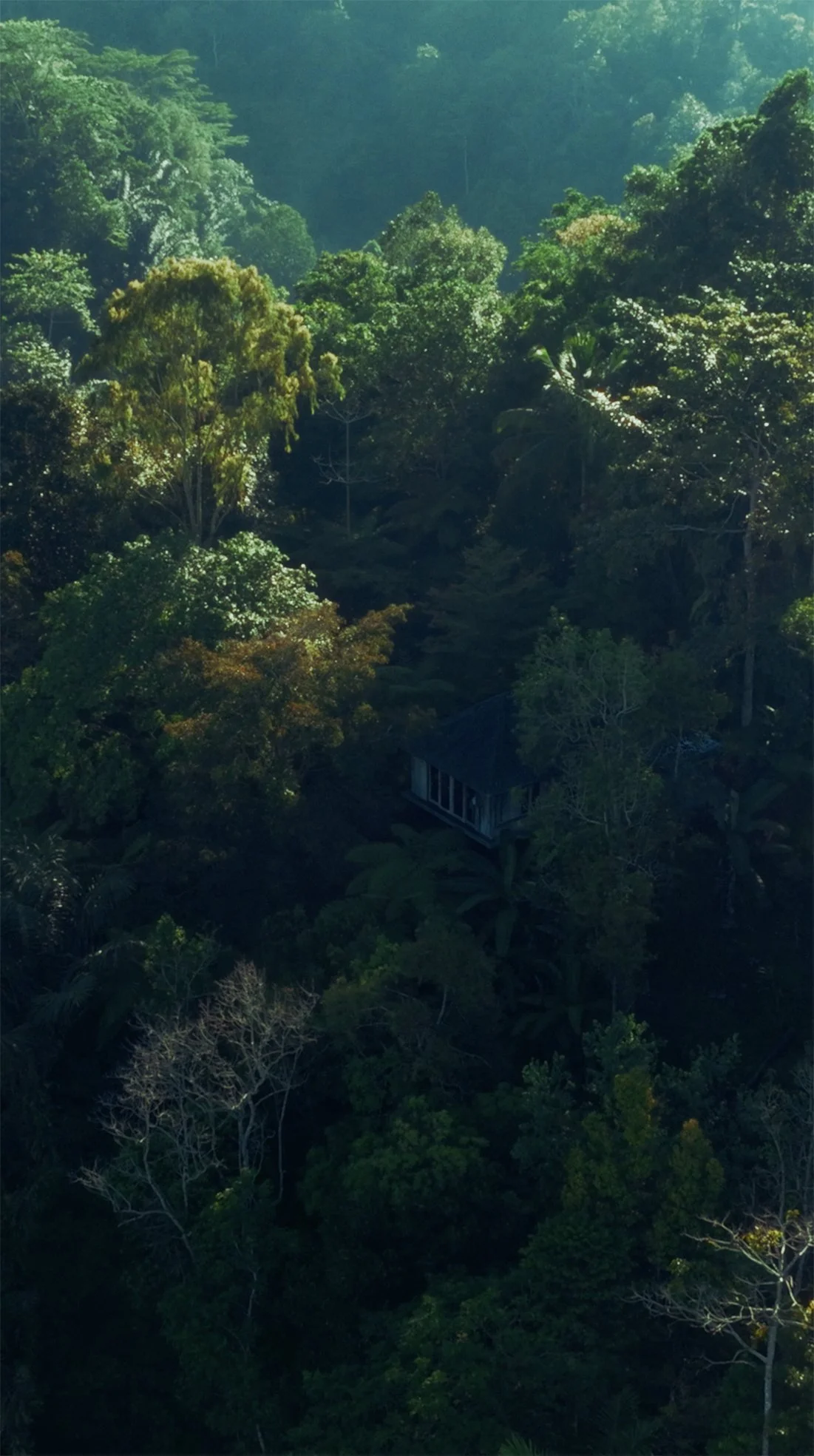
The view at Tian Taru
Olivier: The project began with a residency at Tian Taru, an indigo studio surrounded by jungle and its own plantation. What did that environment bring to the work?
Inge: Tian Taru is a quietly designed place where the architecture, studio, jungle and indigo plantation are all connected. From sunrise until sunset, I felt as though nature was trying to tell me many things at once.
Being able to observe the complete process of indigo changed my understanding of colour. You see the plants growing, the leaves fermenting, and the pigment paste oxidising with limestone and light. None of that experience is present when you simply hold a tube of paint.
The beauty and power of natural colour are found in the slowness of its transformation. That a green leaf can become such a deep, dark blue remains almost unbelievable to me.
Indigo behaves like a living colour during the dyeing process. In painting, I usually construct colour layer by layer, searching for its vibration and for the way light travels through it. At Tian Taru, I saw colour come alive in another way.
Indigo reminds me of the depths of the ocean, the landscape after sunset and the reflection of infinity. I am interested in the moment when colour no longer appears fixed but seems to move, breathe and exist somewhere between light and matter, a colour that appears to have no end.

Bark works at Mauna Garden
Olivier: Did the residency feel like learning a technique or entering a larger philosophy?
Inge: Both, although the most important lesson was learning to feel the material more deeply.
I had to let go of the thinking process at certain moments and place greater trust in my hands. My conversations with Tian Taru’s founder, Seba Mesdag, were also very inspiring. He originally trained as a painter in London before developing his practice as a landscape architect, and he brought his knowledge of natural dyeing from India to Bali.
We spoke about the many ways a passion for nature can take form through architecture, spatial experience, objects or painting. My artistic process at Tian Taru remained very autonomous, but the encounter opened new perspectives for both of us.
Olivier: Your investigation expanded through Pagi Motley in Sembiran, North Bali. How did that collaboration begin?
Inge: Seba introduced me to Pagi Motley’s founder, Andika Putra. Initially, my intention was simply to prepare the bark cloth with a mordant in his studio so it could absorb the natural pigments more effectively.
From our first meeting, however, I felt that we were artistically on the same wavelength. Andika has extensive experience in natural dyeing, fashion and textiles, although bark cloth was also a new material for him.
The studio was a meeting point for international fashion projects, designers and makers who shared a passion for colour. I quickly realised that I wanted to remain there longer and develop the experiments further.
The conceptual direction remained mine, while Andika and the studio team supported the technical aspects of dyeing particularly because of the large scale of the works. Much of our communication happened through the materials and through working with our hands.
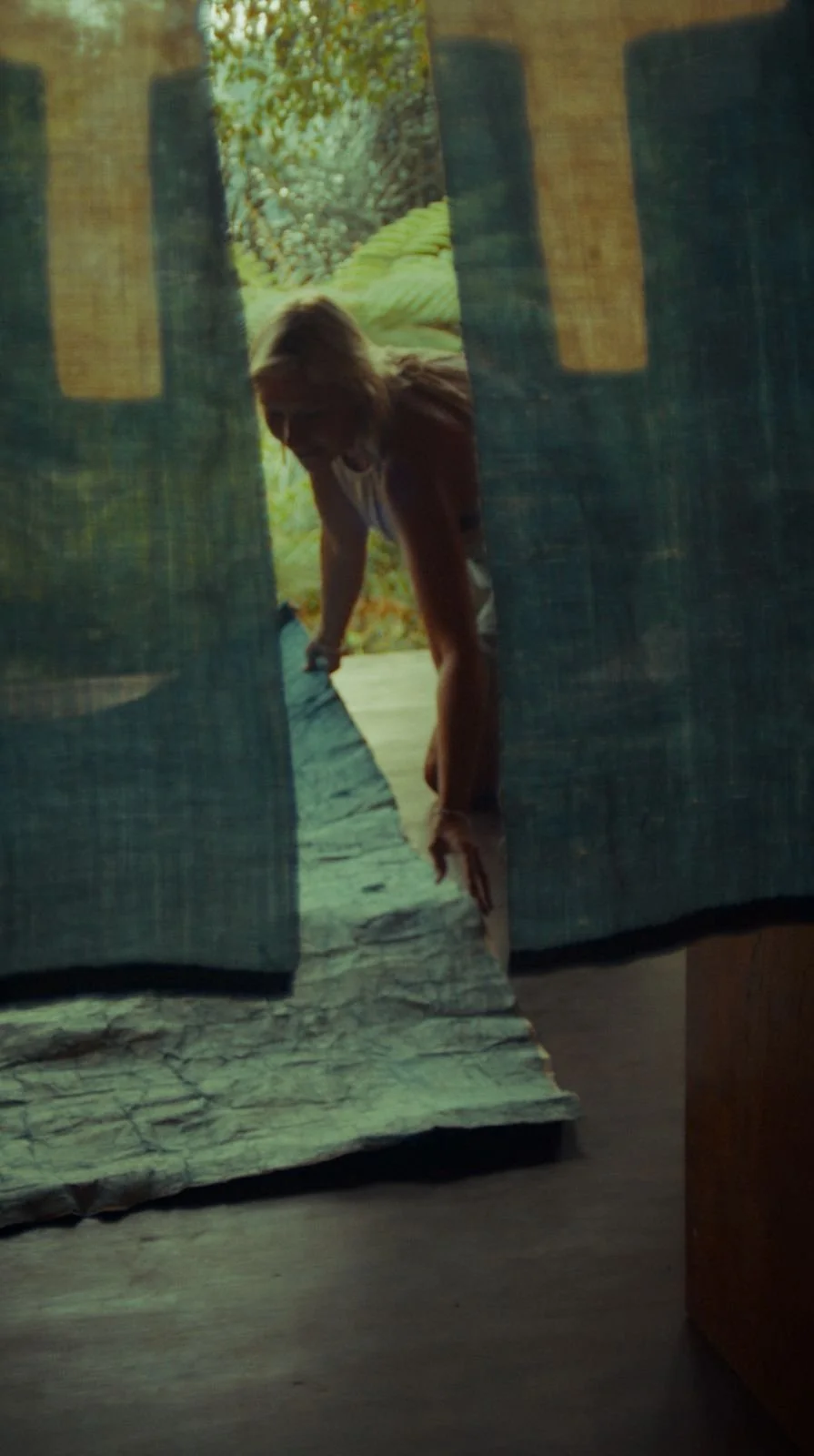
Inge Cornil coloring with Indigo at Tian Taru
Olivier: Which of the local pigments surprised you most?
Inge: Indigo remains the most fascinating to me because it is so alive. It contains an extraordinary number of variations, depending on oxidation and the timing of the dyeing process. Its intensity and depth cannot be experienced in quite the same way through another pigment.
Sappan wood has a very warm presence. Its saturation softens as it dries in the sunlight, so the colour continues to evolve after it has been applied.
Natural colour is never completely predictable. I would discuss the possibilities of an experiment with Andika, but the process always retained an element of surprise. Sometimes what I had considered the reverse side of a work became the front, and then changed again. The artwork remained open until the final action.
Not a single piece was lost. Even the apparent failures became material for reconsidering the work.
Olivier: Does understanding where a colour comes from change the act of using it?
Inge: Completely. It gives the material an identity and creates respect for the journey through which the colour has come to life.
We often romanticise the word “natural,” but working with nature requires patience. You have to respect the rhythm of different elements coming together. The material will not automatically follow your intentions.
The bark cloth does not reveal itself immediately. It imposes a limit on how many layers it can accept. At the same time, the structure of the bark brings a richness that conventional canvas could never offer.
In the finished BARK WORKS, matter and colour are inseparable. The works carry the story of all these processes, but nature remains the central character.

Bark works at Mauna Garden
Olivier: Natural pigments can continue to shift with light, humidity and time. Do you consider that instability a problem or part of the work’s life?
Inge: Nature is changeable. An artwork made from the natural landscape cannot remain entirely motionless.
On one hand, I try to capture a moment and preserve its movement as a document in time. On the other, I have entered into a relationship, a kind of pact, with nature. That means I am not the final decision-maker.
I often think of Anselm Kiefer, whose work allows transience and material transformation to become part of its power. Perhaps an artwork can remain alive precisely because it is not completely fixed.
Light, colour and time have always been inseparable in my practice. In BARK WORKS, that relationship became even stronger because I had to align myself fully with the rhythm of nature. Light was not simply illuminating the work. It was directing the process.
Olivier: Your earlier series, including EARTH WORKS, SEA WORKS and OCEAN WORKS, address humanity’s impact on the natural environment. How does BARK WORKS differ?
Inge: The earlier works grew from research into the human footprint: large-scale deforestation and immense accumulations of waste within natural environments. Through layers of powdered pigments, I tried to express the scar tissue of Mother Earth.
BARK WORKS begins from another position. It develops directly according to the rhythm of nature and is less focused on humanity as a disruptive force.
I believe a painting can carry environmental responsibility without becoming didactic. A viewer may first connect with a work aesthetically, through its beauty, material or colour. The deeper context can reveal itself afterwards.
That first moment of beauty does not weaken the message. It can allow someone to enter the story more deeply.
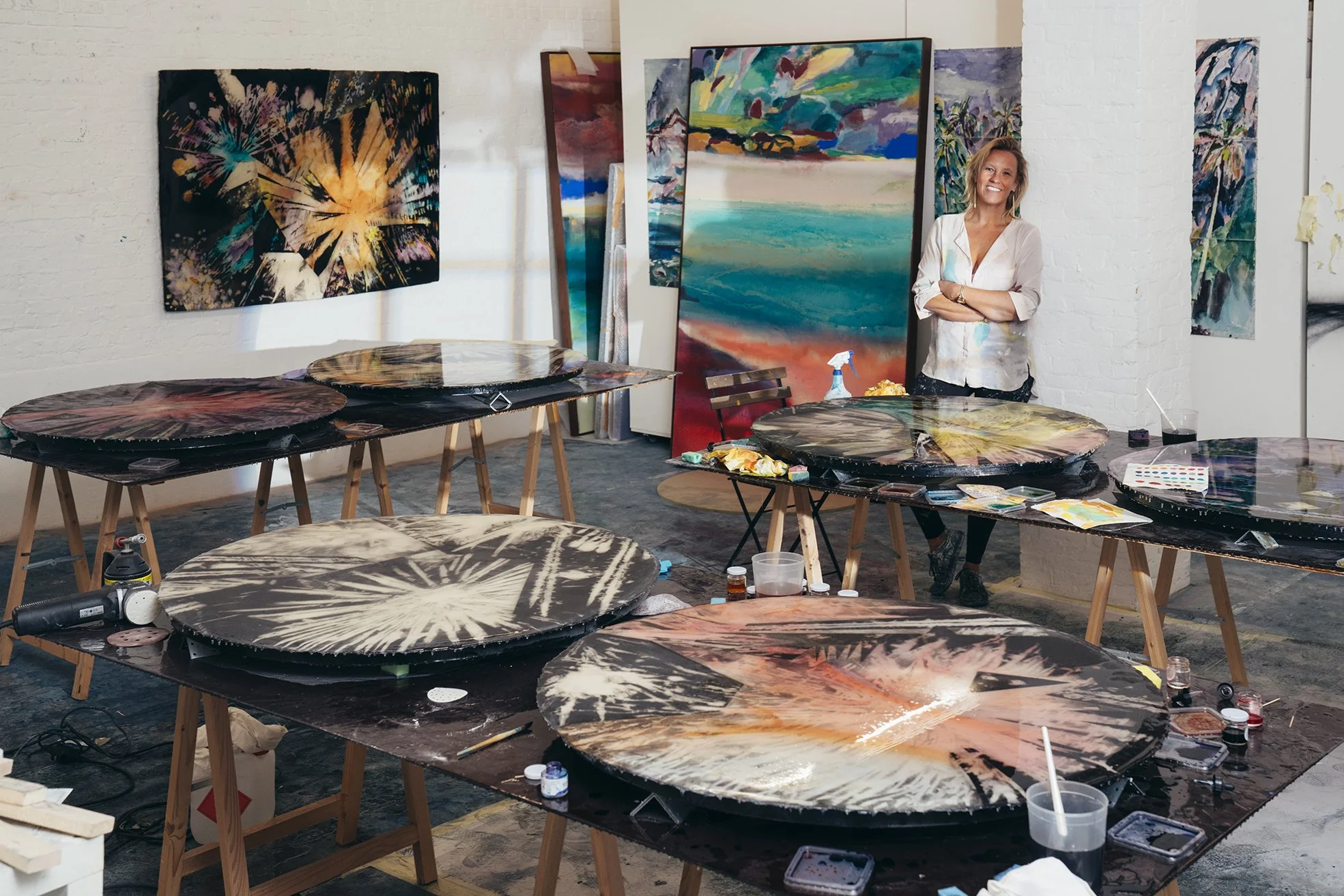
Previous works by Inge Cornil using different materials in her studio in Antwerp.
Photo courtesy of Filip van Roe
Olivier: There is also a tension in your wider practice between organic pigments and industrial materials such as epoxy and UV varnish.
Inge: My work often exists where two apparent opposites meet: art and science, craftsmanship and experiment, the organic and the chemical.
These materials are always used in service of the artistic concept in the way I bring together light, depth, matter and layering.
Industrial and chemical materials demand mathematical precision. Knowledge, application, timing and vigilance are inseparable, and there is little room for artistic flexibility. Nature is more generous in some ways, but it also determines its own rhythm. I am interested in what happens when these different systems meet.
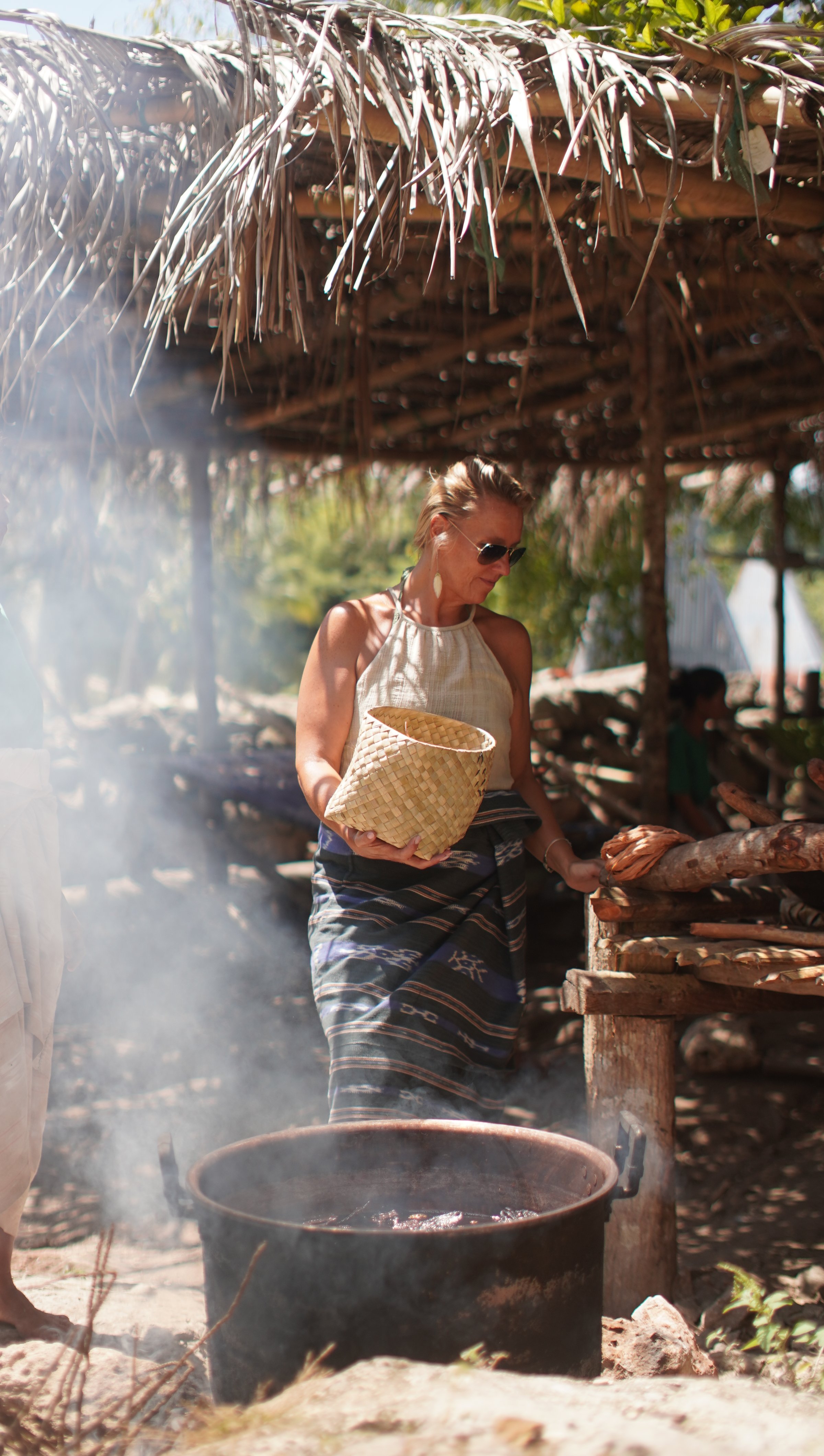
Inge Cornil on Sumba
Olivier: What was hardest about leaving Bali?
Inge: I miss the gentleness of the people, the closeness to nature, the powerful energy and, of course, the tropical light.
I first experienced Bali’s exceptional energy nineteen years ago. It has continued to bring me back.
The creation of BARK WORKS left me with an enormous feeling of gratitude towards nature. After a long period of artistic research, it felt like coming home. It was as though pieces of a puzzle had finally come together, while simultaneously opening many new ideas and possibilities.
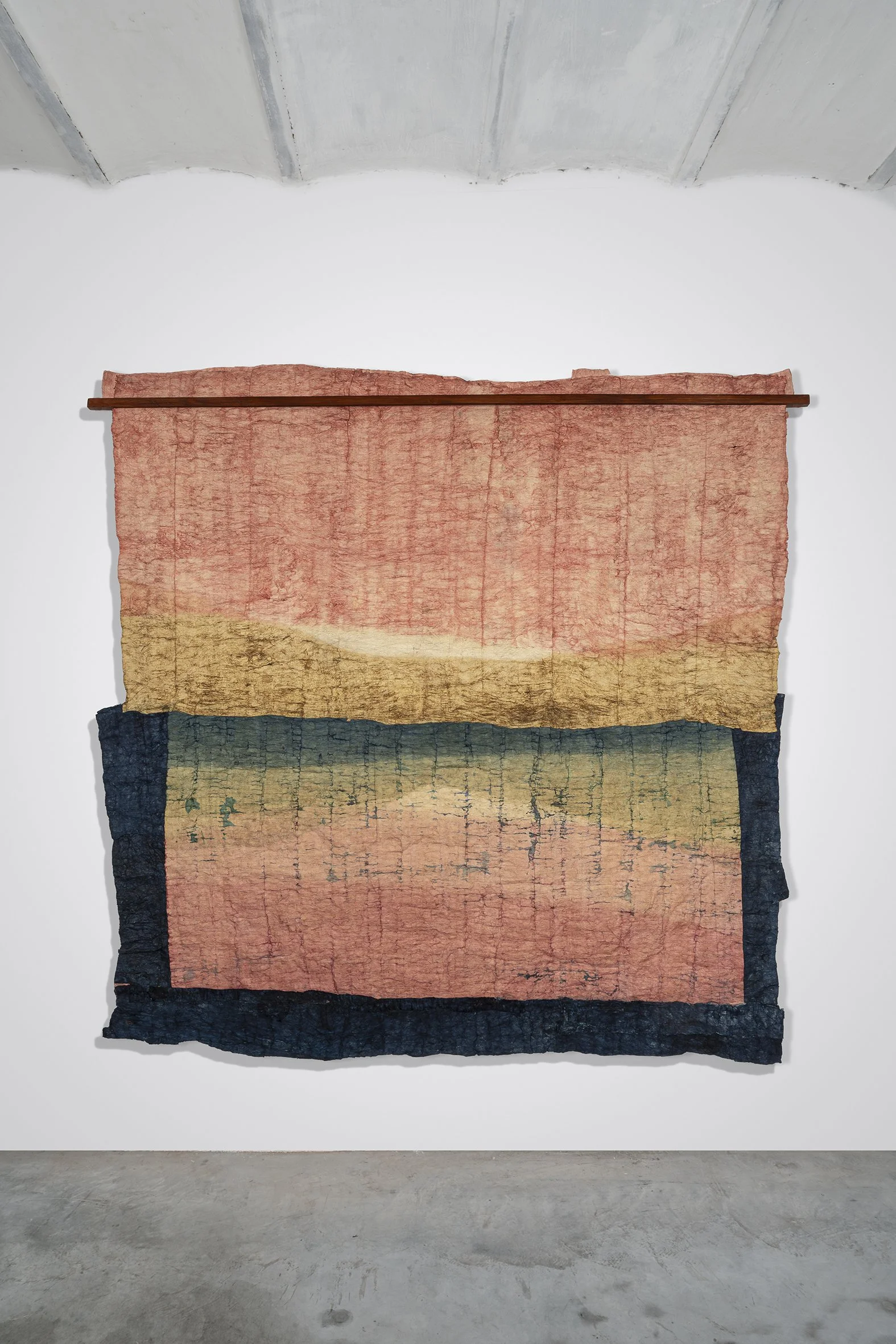
Bark works by INge Cornil in her studio in Antwerp ± 200×200cm
Olivier: What happens when these works leave Bali and enter the controlled architecture of a European gallery or collection?
Inge: They carry part of the tropical experience into another world.
The work continues to live through the light and spatial conditions in which it is presented. The pigments draw the viewer into the intense palette of the landscape, while the transparencies and layers of the bark cloth create a constantly changing experience.
I hope the works can function as windows towards infinity as a connection to nature and to the artistic journey behind them.
Olivier: Where might this journey take you next?
Inge: I would like to explore colours derived from minerals in mountainous environments. I am also drawn to the possibility of researching natural dyeing in the Amazon.
Colour exists everywhere in the world. It gives me the energy to continue searching.
Perhaps I am looking for both new landscapes and a different way of belonging to the world. The search may begin with the landscape, but something deeper emerges through the immersion in nature, the culture and the encounters with local people.
That is ultimately what travelling gives me: not simply a new place to observe, but another way of coming home.
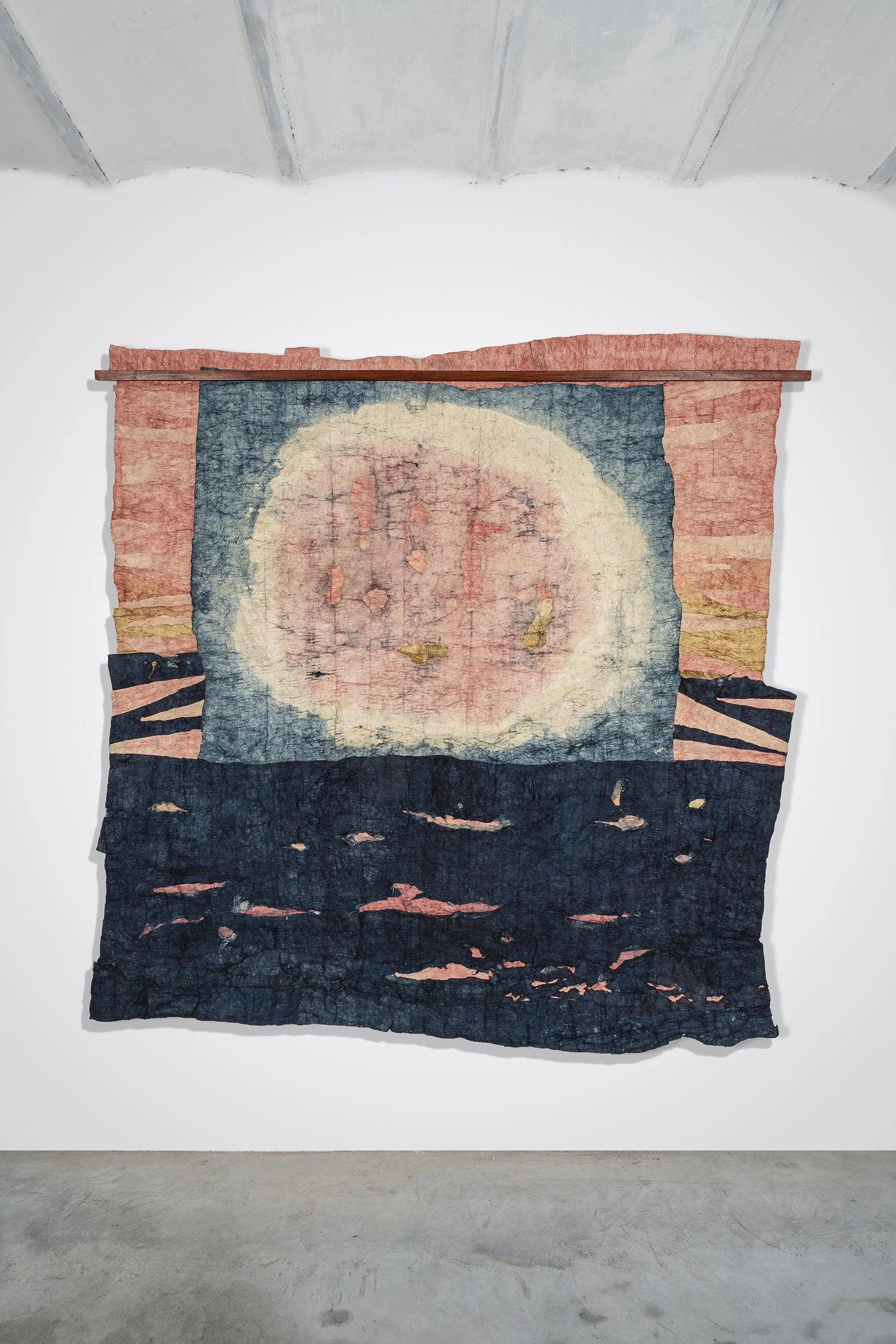
Bark works by Inge Cornil in the studio in Antwerp. ±200×200cm
A selection of works from Inge Cornil’s BARK WORKS is available. For further information, private viewings or enquiries, please contact Olivier Varossieau.