Yayoi Kusama, 1929–2026: A Life Devoted to Art
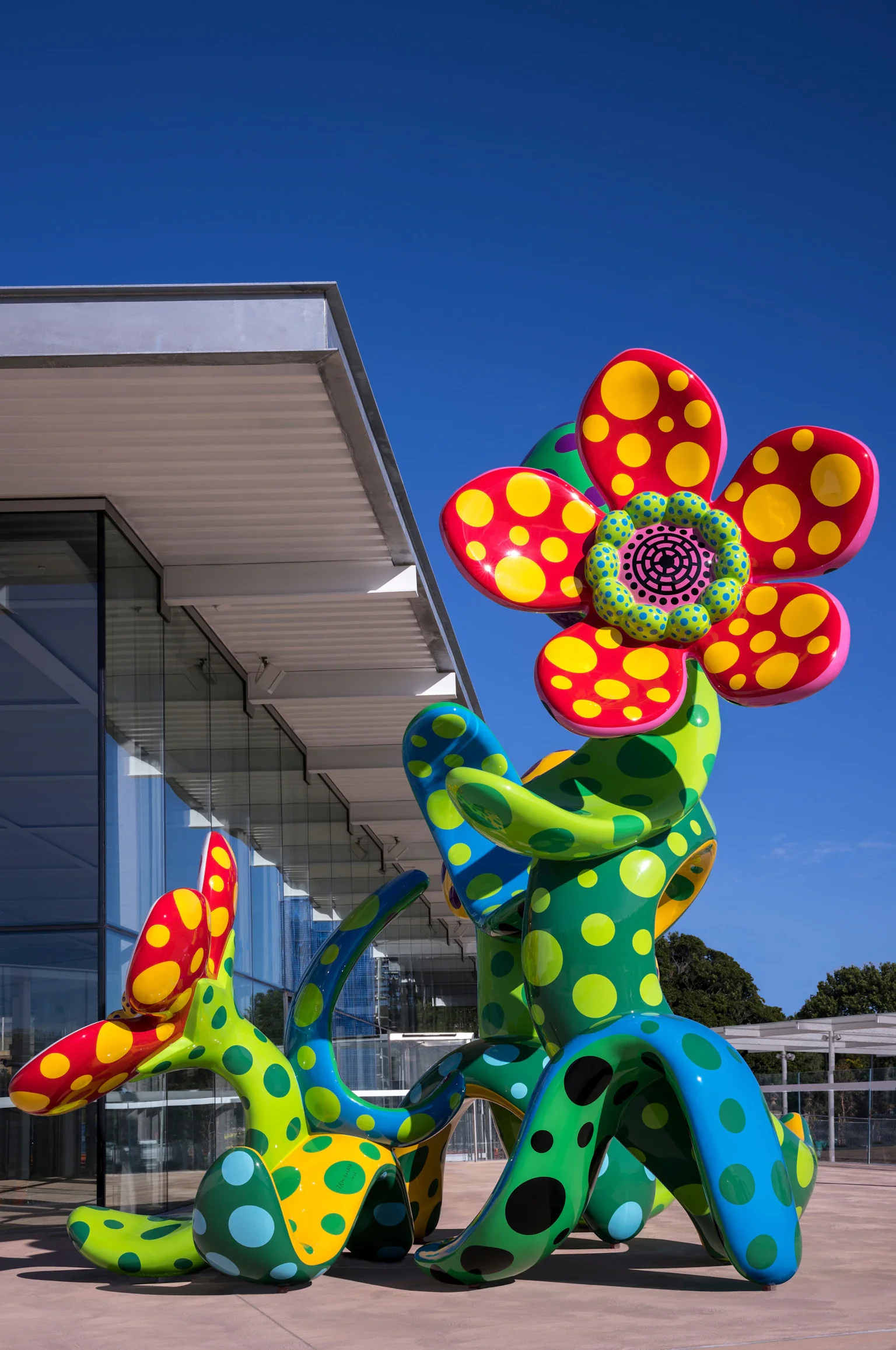
Yayoi Kusama Flowers that Bloom in the Cosmos 2022, Art Gallery of New South Wales © Yayoi Kusama, photo © Brett Boardman
Yayoi Kusama leaves behind one of the most distinctive bodies of work of the past century.
Over more than seven decades, she worked across painting, drawing, sculpture, installation, performance, film, fashion and literature. Her practice was remarkably broad, yet always recognisably her own. Dots, nets, flowers, pumpkins and reflections became part of a visual language through which she explored infinity, repetition and our place in the universe.
Her work reached an audience far beyond the traditional art world. Its familiarity, however, should not obscure its complexity. Behind the colour and apparent playfulness is an artist who spent her life giving form to deeply personal experiences of nature, compulsion, vulnerability and self-obliteration.
The origins of Kusama’s visual language
Kusama was born in Matsumoto, Japan, in 1929. Her family ran a seed business and plant nursery, surrounding her with flowers, pumpkins, fields and repeating forms of organic growth.
Nature remained important throughout her life. Flowers could represent beauty and renewal, but also proliferation and mortality. Pumpkins recalled her childhood and appealed to her because of their modest, generous and slightly awkward form. Dots could be understood as cells, seeds, planets or individual lives within an immeasurable universe.
Kusama also experienced visual and auditory hallucinations from childhood. Patterns appeared to spread beyond their original surfaces, covering rooms, objects and sometimes her own body. Art gave her a way to make these experiences visible.
This is essential to understanding her work. The dots were never simply decorative. Nor were the repeated nets, flowers and soft sculptural forms. They came from a private experience of the world and gradually became a language that others could enter.
Kusama described the disappearance of the individual within a repeated pattern as “self-obliteration”. A person, object or room covered in dots ceased to stand alone and became part of something larger.
As she expressed it:
“Our earth is only one polka dot among a million stars in the cosmos. Polka dots are a way to infinity.”
Kusama initially trained in Nihonga, a traditional Japanese painting discipline. She found its conventions restrictive and increasingly pursued her own form of abstraction. Her early work entered into conversation with Surrealism and the international avant-garde, but its principal sources remained her visions, nature and her fascination with infinity.
New York and the Infinity Nets
Kusama left Japan for the United States in 1957 and settled in New York the following year.
Abstract Expressionism was still dominant, but she chose a quieter and more obsessive form of painting. Her early Infinity Net works were built from thousands of small, repeated arcs. They had no obvious centre and appeared capable of continuing beyond the edges of the canvas.
From a distance, these paintings could seem restrained. Up close, the labour and intensity of their making became visible.
During the 1960s, Kusama moved beyond painting. She covered furniture, clothing, shoes and boats with repeated soft forms. She created mirrored environments in which objects and viewers appeared to multiply without end. She also organised performances and public happenings concerned with sexuality, personal freedom and opposition to war.
Her work developed alongside Pop Art, Minimalism, performance art and the emerging feminist movement, but it never belonged entirely to any one of them.
Long before immersive art became widely familiar, Kusama was creating environments that placed visitors inside the work. The viewer no longer stood at a safe distance from a contained object. Reflections, patterns and repeated forms made the viewer part of the experience.
Kusama’s position in New York was not an easy one. She was a Japanese woman working in an art world largely controlled by Western men. Recognition was inconsistent, and ideas close to those she had pioneered were sometimes more readily celebrated in the work of her male contemporaries.
She nevertheless continued with extraordinary determination.
Kusama in Amsterdam and the Netherlands
Kusama’s relationship with the Netherlands is an important, and sometimes overlooked, part of her history.
She began exhibiting in the country in the early 1960s, when Amsterdam and several other Dutch cities were becoming centres for experimental art and counterculture.
Her Aggregation: One Thousand Boats Show was included in the landmark Nul 1965 exhibition at the Stedelijk Museum Amsterdam. A boat covered with repeated soft forms was placed within a room wallpapered with hundreds of reproductions of the same image. The boat was no longer a single object. It appeared to have taken possession of the entire space.
Kusama returned to the Netherlands several times during the second half of the decade. She worked and exhibited in Amsterdam, The Hague, Delft and Schiedam, developing relationships with local artists, photographers, galleries and collectors.
In 1967, she staged a body-painting happening at the Birds Club in Amsterdam. Photographs by Harrie Verstappen show her extending the language of dots from paintings and sculptures onto bodies and into social space.
The photographs from these Dutch years are particularly revealing. Kusama understood that photography could do more than document an exhibition or performance. It allowed her to shape how she and her work would be seen.
In some images, she almost disappears into her surroundings. In others, she stands confidently at the centre of the composition in carefully chosen clothing. These were not casual portraits. Kusama was constructing her own image at a time when women, and particularly Asian women, were often marginalised or exoticised by the Western art world.
Kusama’s connection with Amsterdam gives the major retrospective now on view at the Stedelijk Museum particular significance. Conceived during her lifetime and opened shortly after her death, the exhibition has become a moving tribute to her life and work. For anyone in Amsterdam, it is an important opportunity to experience the full scope of her practice, from the early paintings and sculptures to her immersive environments.
The global popularity of Kusama’s pumpkins, flowers and mirrored rooms made her one of the most recognisable artists in the world.
Beyond dots and pumpkins
Their success can make it easy to overlook the more difficult side of her work.
Her art deals with fear, compulsion, isolation, sexuality, illness and death. Joy and unease often exist together.
Mirrors create spectacular environments while making it difficult for viewers to locate themselves within them. Flowers can suggest growth and celebration, but also multiplication and decay. Dots connect individual forms while slowly making them disappear.
That tension is central to Kusama’s work. It draws people in before quietly unsettling their sense of scale, space and identity.
Her importance cannot be explained by the fame of a single motif. Kusama changed the relationship between artwork, space and audience. She helped establish the immersive installation as a serious artistic form and showed that an intensely personal experience could become a language understood across cultures and generations.
In 1993, she represented Japan at the Venice Biennale. Major international exhibitions, museum acquisitions and public commissions followed. Recognition came late, but on an extraordinary scale.
Through it all, Kusama continued to return to the questions present in her earliest work: how we relate to nature, how an individual exists within the universe and whether repetition can offer a way through fear.
Her passing marks the end of a remarkable life in art. The work remains joyful, unsettling and quietly radical.
For collectors
For readers with a professional collecting interest, we have prepared a separate guide explaining how paintings and sculptures by Yayoi Kusama are bought and sold privately.