Adam Pendleton: Some Wild Kind of Language

Adam Pendleton, Black Dada (A), 2024. Silkscreen ink and black gesso on canvas, two parts. 96 x 76 inch / 243,8 x 193 cm. Courtesy of the artist and Mennour, Paris, private collection. Photo Andy Romer
From Kunstverein to the Stedelijk Adam Pendleton returns to Amsterdam with an exhibition that transforms how we see painting, history and the museum itself
This autumn, Adam Pendleton returns to Amsterdam for Some Wild Kind of Language, his first museum exhibition in the Netherlands. Opening at the Stedelijk Museum Amsterdam on 10 October 2026, the exhibition marks a significant moment in the career of one of the most distinctive artists working today—and renews a connection with Amsterdam that began at Kunstverein in 2009, at the very beginning of his international career.
Bringing together eleven paintings and eight monumental drawings, many newly made and never previously exhibited, Some Wild Kind of Language presents Pendleton’s most recent thinking about abstraction, language and space. Yet the exhibition does not treat these works as isolated objects. Paintings, drawings, architecture and the history of the Stedelijk are brought into a single, active relationship.
Pendleton describes the kind of awareness created through these encounters as a “geometry of attention.” Our focus does not remain fixed. It moves between a painted gesture and a printed letter, between surface and architecture, between the immediate experience of a work and the cultural histories it carries.
Abstraction, in Pendleton’s hands, is not a retreat from the world. It is a way of entering it differently.
From poetry to painting
Born in Richmond, Virginia, in 1984, Pendleton began writing poetry and making art at a young age. He completed high school two years early and left the United States at sixteen to study art in Pietrasanta, Italy. At eighteen he moved to New York, determined to establish himself as an artist.
Those beginnings matter because Pendleton has never treated painting as a self-contained discipline. His practice emerged through poetry, performance, music, publishing, film and visual art simultaneously. Words were never merely captions or explanations; they were materials with their own rhythm, texture and historical weight.
His breakthrough performance, The Revival, was commissioned for Performa in New York in 2007. Pendleton appeared as a secular preacher, accompanied by pianist Jason Moran and a thirty-person gospel choir. The work brought together the emotional structure of a religious revival meeting with experimental poetry, political speeches, queer discourse and the musical traditions of the Black church.
Rather than telling a conventional autobiographical story, Pendleton assembled a shifting field of voices. Language was repeated, redirected and placed into unexpected relationships. The performance demonstrated something that would become fundamental to his practice: existing words and images can be transformed not by erasing their histories, but by changing the structures in which we encounter them.
Although his current work is most often discussed in relation to painting, something of this performative energy remains. Pendleton wants an ostensibly static artwork to feel alive—to hold the viewer’s attention while continually reorganising it.

Adam Pendleton, 2024. Photo Matthew Septimus
Painting through translation
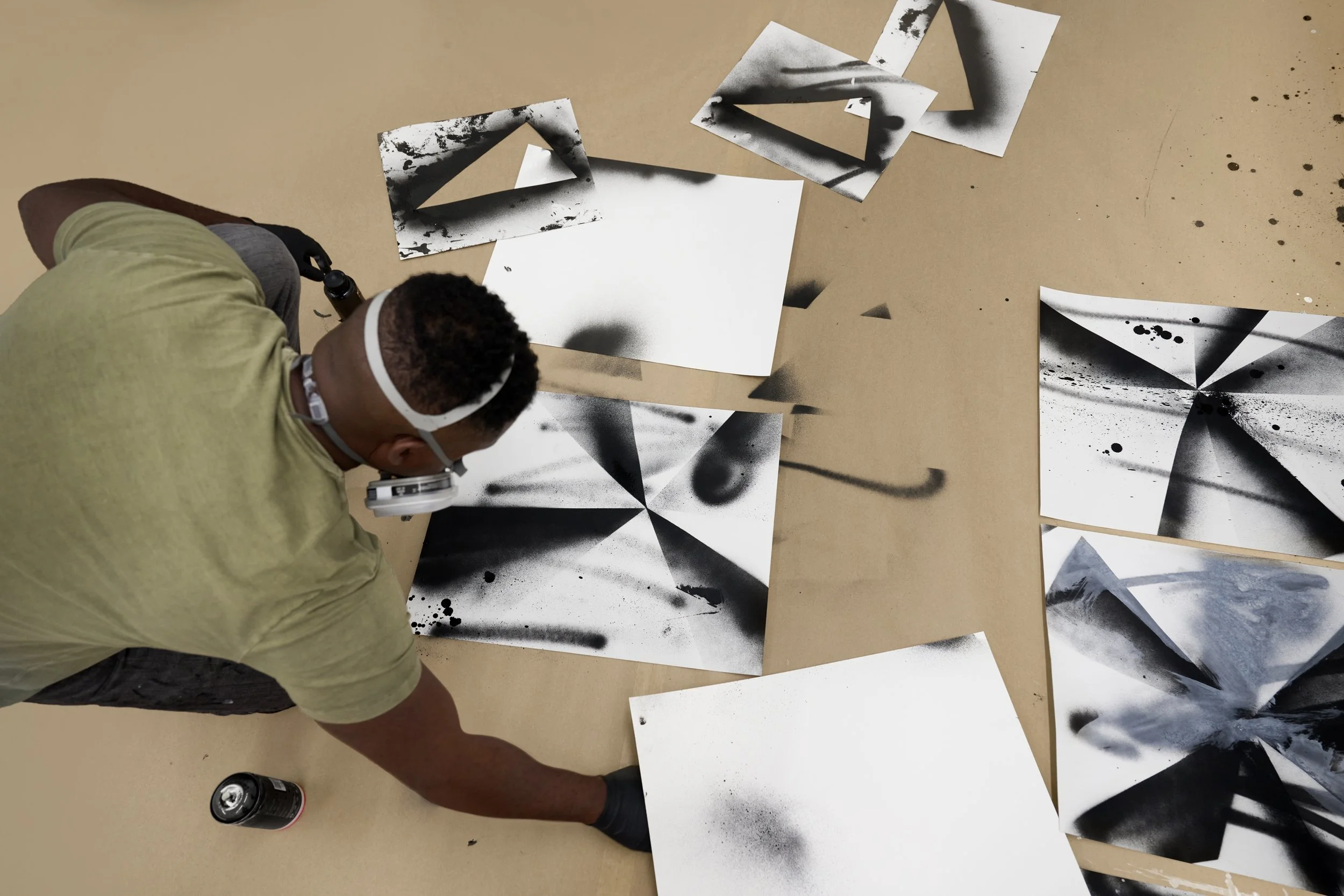
Pendleton’s paintings begin with direct experimentation on paper. He uses paint, ink, watercolor and spray paint, combining freely made gestures with stencilled words, broken letters, graffiti-like marks and geometric forms.
These initial compositions are then documented, photographed, enlarged, rearranged and layered through screenprinting. A spontaneous mark is translated into an image and subsequently returned to the physical surface of a painting.
The process deliberately confuses distinctions between the handmade and the mechanical. A drip may look immediate, yet it has passed through photography and reproduction. A carefully printed element may originate in an uncontrolled movement of the hand. Painting, drawing, photography and printmaking coexist within the same surface.
Adam Pendleton, 2023. Photo Jason Schmidt
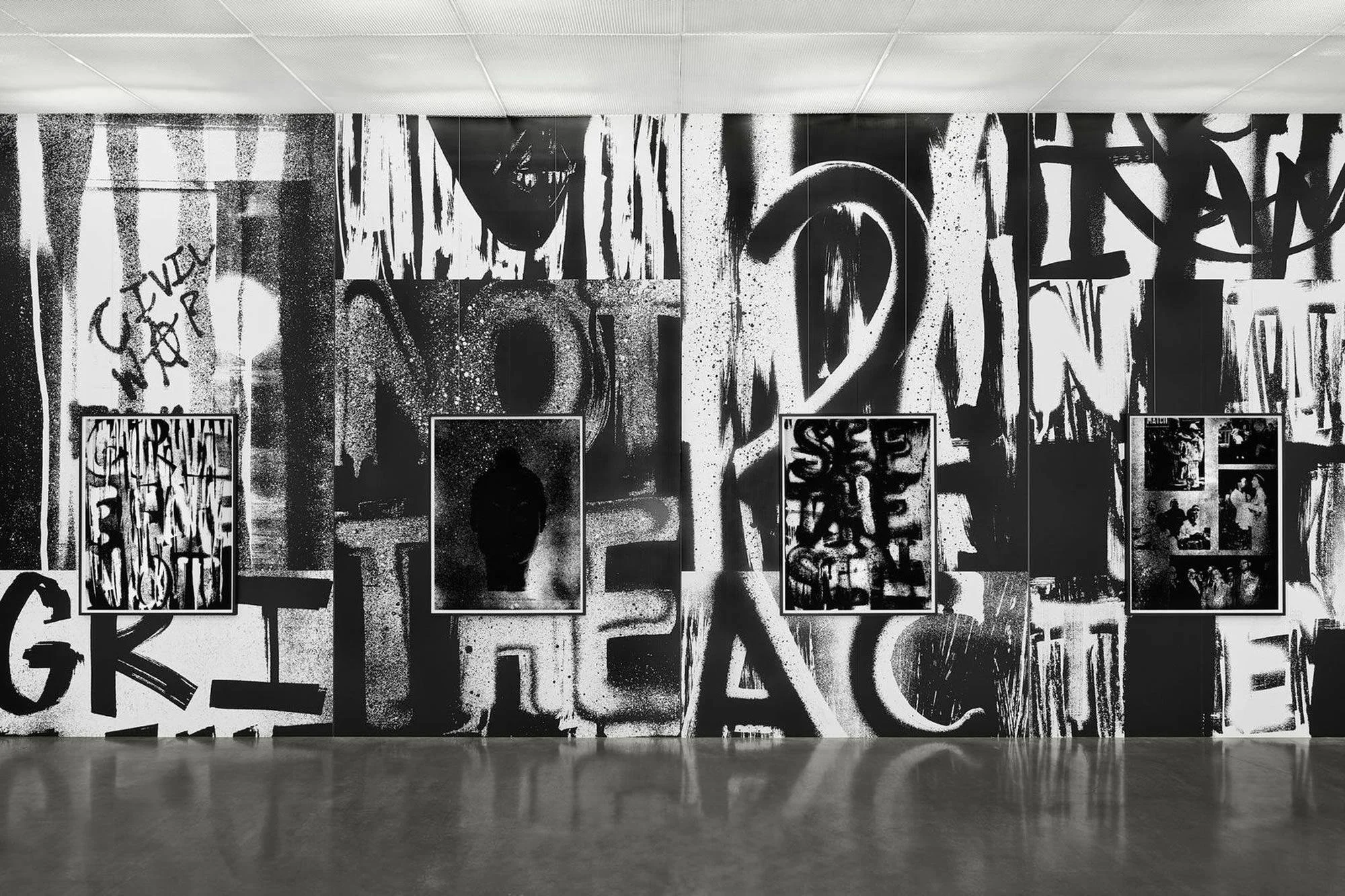
Pendleton does not organise these elements around a single centre. Instead, they extend across the canvas in what the artist and the Stedelijk describe as an “all-over” condition. The eye cannot settle permanently on one image or statement. It moves continuously across fragments and interruptions.
Language is often visible but only partially readable. A word may be obscured, enlarged beyond recognition or reduced to a shape. This interruption is not a failure of communication. It encourages another kind of engagement, somewhere between seeing and reading.
Pendleton’s paintings ask us to notice how meaning is constructed—and how rapidly it can change.

Adam Pendleton, Black Dada (A), 2024. Silkscreen ink and black gesso on canvas, two parts. Courtesy of the artist and Mennour, Paris. Photo: Andy Romer.
Black Dada
Since 2008, Pendleton has developed his practice through an evolving framework he calls Black Dada.
The term connects Blackness with the experimental legacy of Dada, the early twentieth-century avant-garde movement that challenged established cultural logic. Its intellectual sources include Hugo Ball’s 1916 Dada Manifesto and Amiri Baraka’s 1964 poem “Black Dada Nihilismus.” But Black Dada is neither a conventional artistic movement nor a recognisable visual style.
It is a method: open, precise and deliberately unfinished.
Black Dada allows Pendleton to examine relationships between Blackness, abstraction, Conceptual art, political speech, experimental poetry and the historical avant-garde. It also challenges expectations imposed on both abstract painting and Black artists. As Pendleton puts it, “Black Dada gives me permission to break rules.”
The framework does not offer a single definition of Blackness. On the contrary, it resists the demand that Black identity should have one appearance, one narrative or one accepted mode of representation. It likewise rejects the idea that abstraction exists outside social and political history.
Pendleton’s Black Dada Reader, published in 2017, offers an insight into this polyphonic approach. It brings texts and images by W.E.B. Du Bois, Sun Ra, Stokely Carmichael, Gertrude Stein, Adrian Piper, Joan Jonas, Hugo Ball, Amiri Baraka and others into a shared space.
No conventional hierarchy separates political theory from poetry, or an avant-garde manifesto from a work of Black radical thought. Sources from different periods are allowed to collide, contradict and transform one another.
This is central to Pendleton’s understanding of history. The past is never truly finished. It is constantly edited and reactivated by the present.
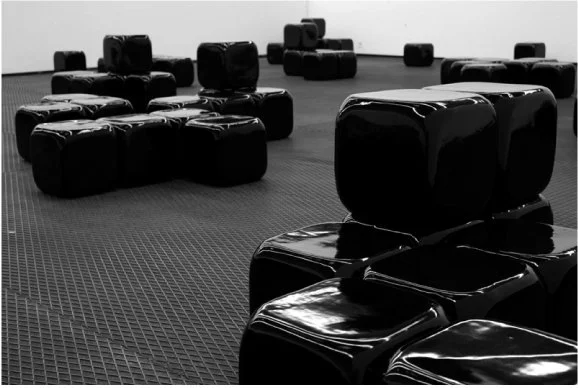
Installation view, Adam Pendleton, grey-blue grain, Kunstverein, Amsterdam, 2009–10. Part of EL T D K Amsterdam, organised with de Appel.
Amsterdam, 2009: grey-blue grain
Pendleton’s connection with Amsterdam began in 2009 through EL T D K Amsterdam, a three-part programme developed by Kunstverein and de Appel.
Its central exhibition, grey-blue grain, was presented at Kunstverein from 12 December 2009 until 31 January 2010. The presentation brought together work made between 2007 and 2009 that explored the abstraction and instrumentalisation of language and imagery.
It included selections from System of Display, in which photographic and textual material was fragmented through glass, mirrors and framing devices. The historical image no longer appeared as an intact piece of evidence; it was reflected, divided and placed in relation to the viewer’s own position.
Other works drew on the coded language of poet Hannah Weiner and incorporated reconfigured material connected to Malcolm X and artist Liam Gillick. Small black ceramic cubes operated like elements in an abstract alphabet: sculptural forms that suggested language without settling into conventional meaning.
A publication accompanying the exhibition assembled writing that Pendleton had appropriated or employed in earlier artworks and performances. It did not merely explain the exhibition. The book was itself part of Pendleton’s practice—another structure through which language could circulate and be reorganised.
The Amsterdam programme also included BAND, a performance and film project presented at De Brakke Grond with de Appel. Taking Jean-Luc Godard’s Sympathy for the Devil as a point of departure, BAND combined footage of the experimental band Deerhoof with material connected to Gertrude Stein and Black Panther Party member Eldridge Cleaver.
Looking back, grey-blue grain contained many of the questions that still drive Pendleton’s work: How can an image carry several histories simultaneously? What happens when words are separated from their original authority? Can an archive be treated as an active, creative material rather than a record of a completed past?
At Kunstverein, these ideas occupied an intimate and experimental setting. More than sixteen years later, they return to Amsterdam on the architectural scale of the Stedelijk.
From white cube to black cube
For Some Wild Kind of Language, Pendleton intervenes in one of the most historically significant parts of the Stedelijk: the central staircase of its original 1895 building.
In 1938, curator Willem Sandberg painted the staircase’s dark brick walls white. When he became director in 1945, Sandberg extended this approach throughout the museum. The staircase consequently became one of the earliest examples of the modern “white cube”—an exhibition space that presents itself as clean, timeless and neutral.
Pendleton transforms this white cube into a black cube.
The intervention is more than a reversal of color. By changing the staircase, Pendleton makes the museum’s architecture—and its supposed neutrality—visible again. He asks us to consider how museums frame our encounters with art, which traditions their spaces were built to support and how institutional histories affect what enters our field of vision.
Inside this transformed space, Pendleton presents eight monumental Basis drawings, the largest drawings he has made to date. Created with gold ink on matte black paper, they occupy the historic niches of the staircase and respond to its scale and architectural rhythm.
Gold is not employed simply as a decorative color. Its visibility changes according to the light and the viewer’s position. Marks alternate between luminosity and opacity, presence and disappearance. As visitors move through the staircase, the works appear to change with them.
Gesture, repetition and accumulation turn each drawing into a record of its own making. Yet no individual gesture is permitted to dominate. The drawings operate as fields of attention in which different elements are continually appearing, receding and returning.
In dialogue with the collection
In the IMC Gallery, also known as the Gallery of Honour, Pendleton’s paintings enter into a direct conversation with the Stedelijk collection.
The exhibition includes paintings from the Black Dada, Days and WE ARE NOT series, in scales ranging up to a monumental work nearly six metres wide. Their presence in this gallery recalls the large-scale postwar abstraction, Color Field painting, Minimalism and Conceptual art that the Stedelijk has historically presented there.
Artists such as Barnett Newman and Morris Louis approached scale, surface and color as vehicles for an immediate encounter. Pendleton both continues and complicates this legacy. He shares their commitment to abstraction and the physical presence of painting, but introduces language, photography, historical fragments and mechanical reproduction into that history.
His work does not dismiss modernism. It reopens it from the perspective of the present.
This dialogue is central to curator and Stedelijk director Rein Wolfs’s understanding of the exhibition. Pendleton’s work connects modernist history to contemporary experience while supporting the museum’s movement towards a more global and plural understanding of art history.
The Stedelijk’s collection is therefore not simply a backdrop. Like the staircase, it becomes an active element in the exhibition—and something that Pendleton’s work invites us to see anew.
An unfinished language
Pendleton has become a central figure in contemporary American painting, with recent exhibitions at the Museum of Modern Art in New York, the Montreal Museum of Fine Arts, mumok in Vienna, the Hirshhorn Museum and Sculpture Garden in Washington and the Langen Foundation in Germany. His work is held in the collections of MoMA, the Guggenheim, the Whitney Museum, Tate, the Hirshhorn and numerous other institutions.
Yet the importance of his practice cannot be measured only through institutional recognition. It lies in his ability to keep fundamental questions open.
What can a painting contain? When does writing become an image? Who controls the organisation of history? Can abstraction be simultaneously formal, emotional and political?
The title Some Wild Kind of Language captures this openness. Pendleton’s visual language is wild not because it lacks discipline, but because it refuses to remain within prescribed boundaries. It moves between painting and poetry, control and spontaneity, politics and abstraction, the archive and the live encounter.
That movement connects the young artist presented by Kunstverein in 2009 to the artist who now occupies the historical heart of the Stedelijk. The scale has changed, but the work’s sense of possibility remains intact.
Amsterdam encountered these ideas early. It will now experience how they have grown into one of the most compelling and intellectually expansive practices in contemporary painting.
Adam Pendleton—Some Wild Kind of Language
Stedelijk Museum Amsterdam
10 October 2026–17 January 2027
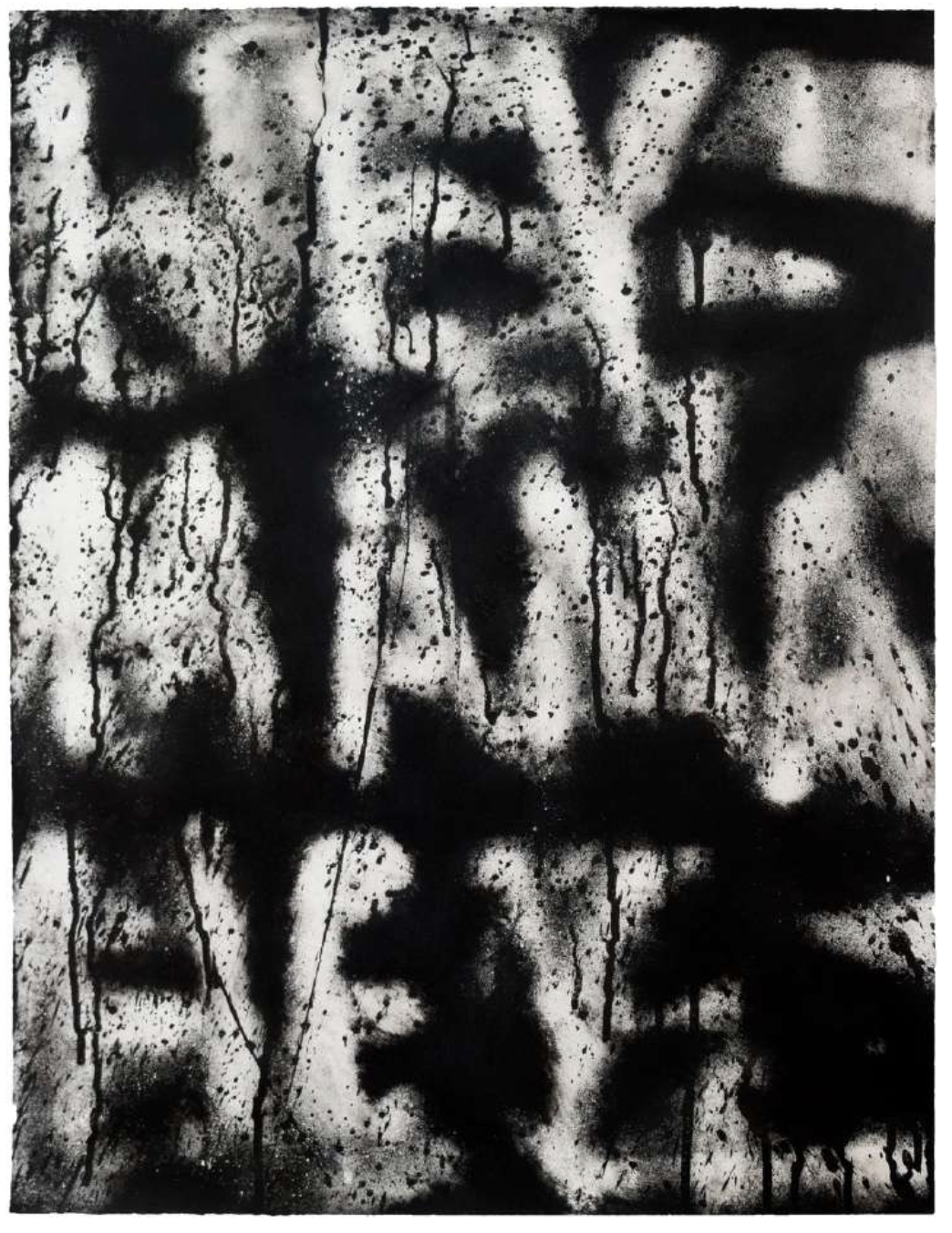
Adam Pendleton
Untitled (Hey Mama Hey), 2021
Enamel screenprint ink on paper with hand applied graphite pigment
65 x 49 inches // ±165×125 cm
Edition of 6
For those interested in exploring Adam Pendleton’s work more closely, we may, where possible, be able to facilitate a personal introduction or private conversation and offer guidance regarding opportunities to acquire a work. All enquiries will be treated confidentially; please contact us for further information.
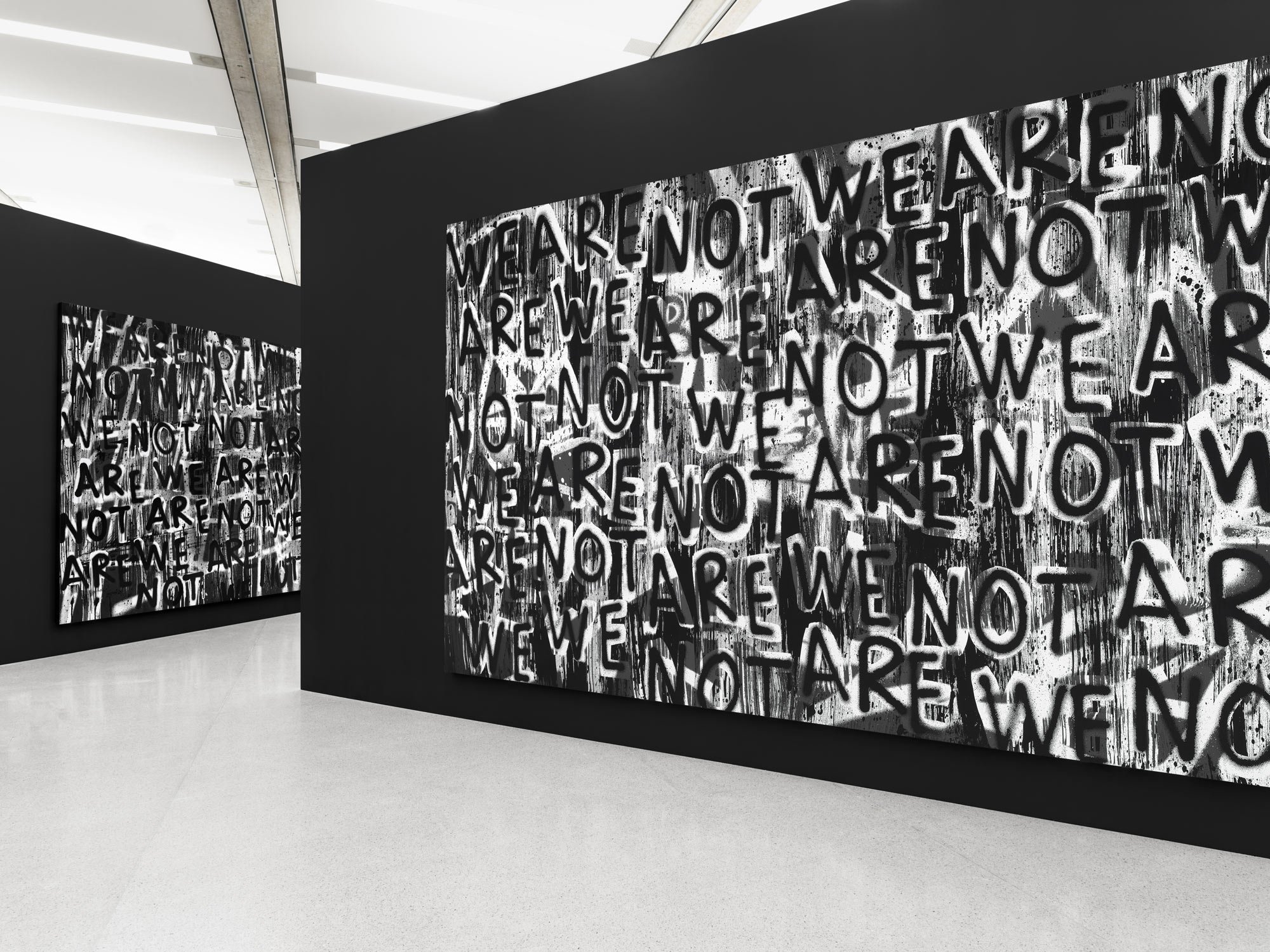
Adam Pendleton
Exhibition view "Blackness, White, and Light", 2023
Photo Klaus Pichler. © mumok