Interview with EVGEN ČOPI-GORIŠEK
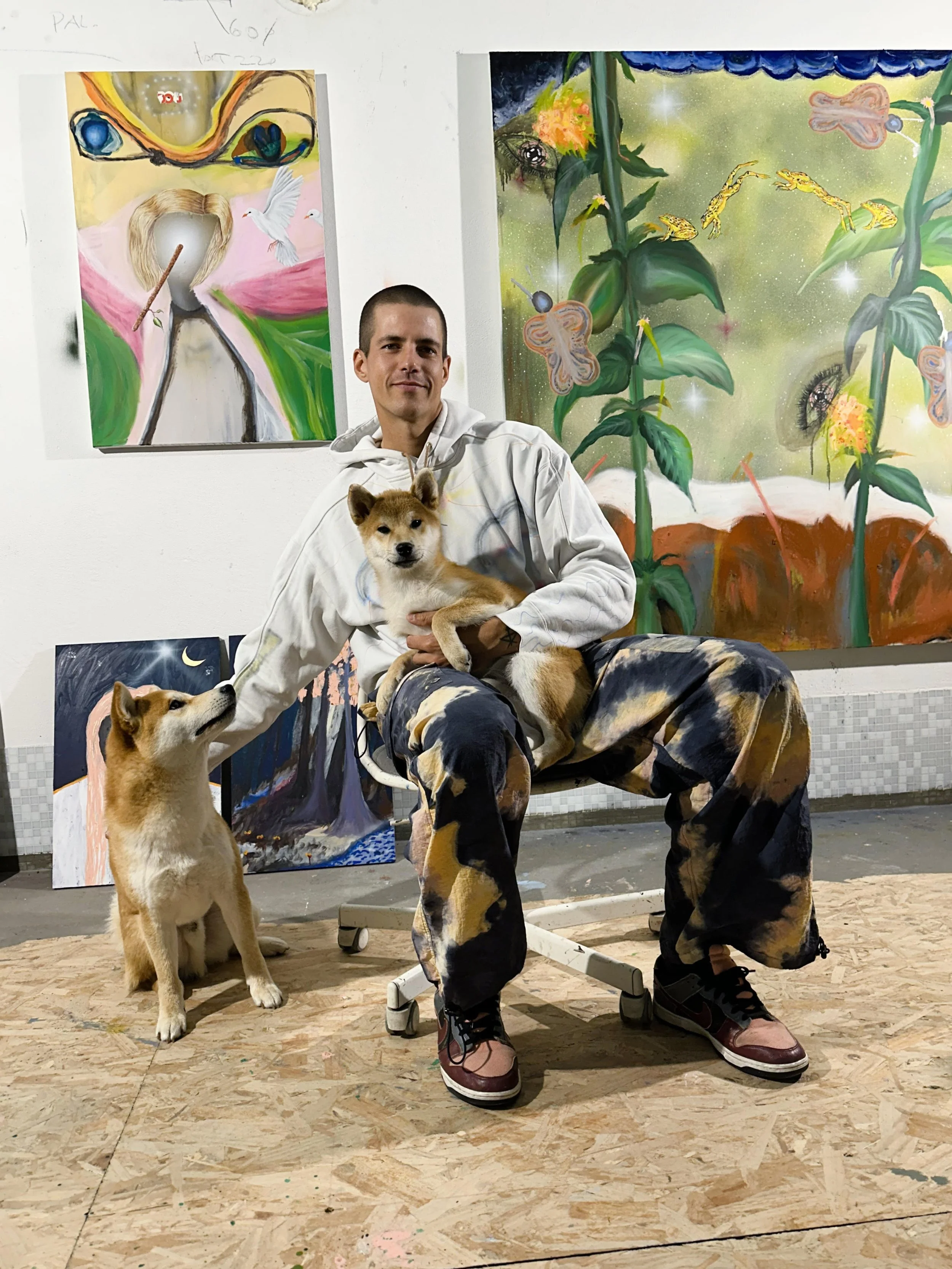
EVGEN ČOPI-GORIŠEK in his studio
Painting Between Global Culture, Emotional Ambiguity, and Contemporary Identity
In conversation with contemporary artist Evgen Copi Gorisek, we discuss the tension between globalization and individuality, the influence of Renaissance painting, emotional vulnerability, and the increasing standardization of contemporary visual culture.
Your paintings balance familiarity with fragmentation. How do you avoid creating images that feel overly universal or detached from lived experience?
I treat the global as a shared backdrop rather than a unified style. My paintings begin with specific, everyday scenes people playing cards, a seated figure, a mother and child rendered with localized details and intimate viewpoints. These familiar situations are then interrupted by shifts in space, scale, and texture, where painterly stains, artificial lighting, or disjointed architecture destabilize the scene. The work exists within that tension between the recognizable and the displaced.
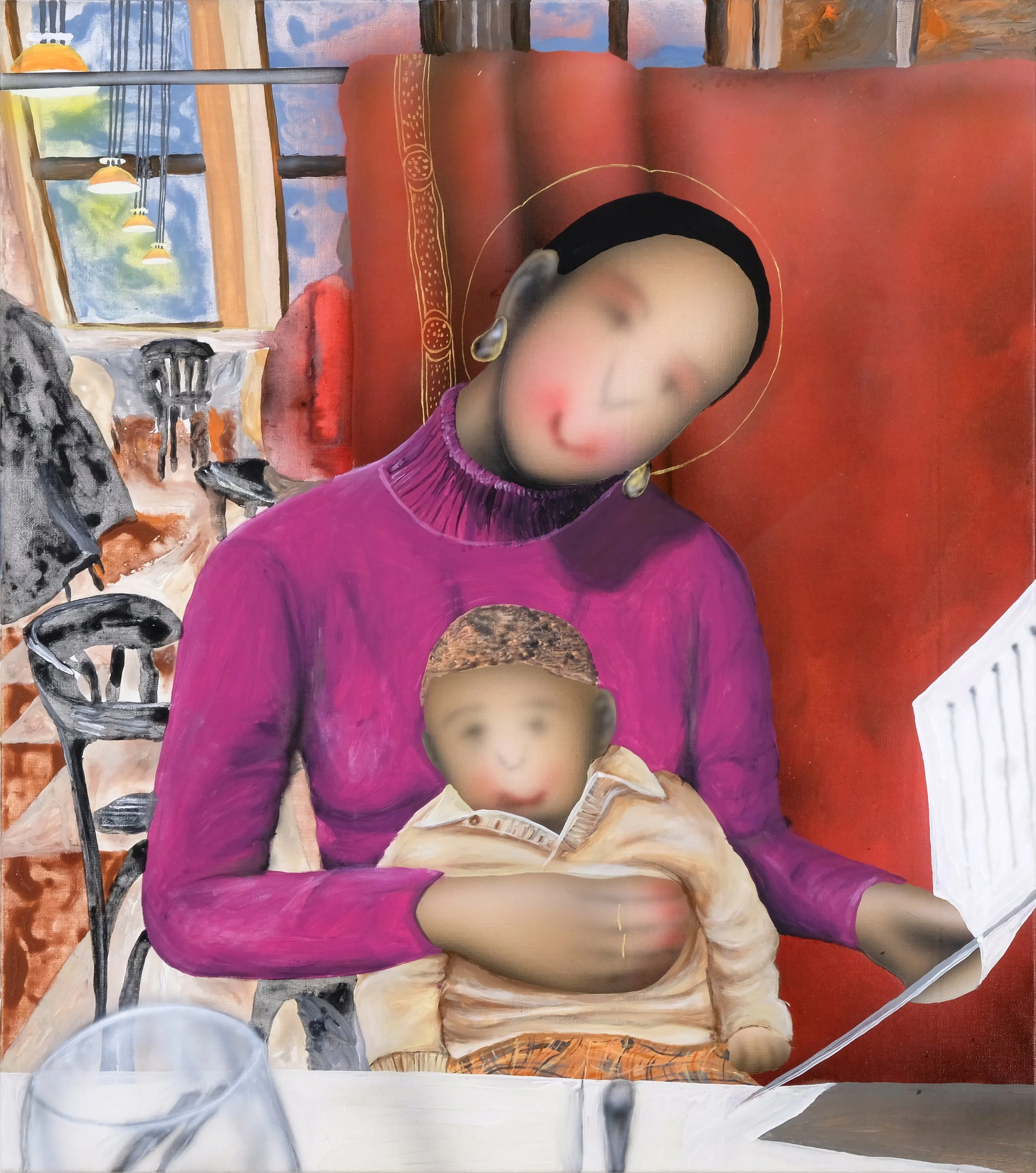
Madonna and Child, 2026
70 x 60 cm
Acrylic and spray paint on linen
To avoid the universal sameness I critique, I preserve friction within the image. Faces remain partially obscured, perspectives do not fully align, and narratives feel suspended rather than resolved. I combine soft, almost generic figures with highly particular environments, allowing them to coexist without completely merging. This creates a sense of specificity that resists the polished, globally legible image we increasingly encounter today.
I also approach each painting as a situated viewpoint. Cropped compositions, layered surfaces, and subtle temporal disjunctions suggest that these scenes are fragments rather than complete narratives. By allowing different visual languages observational painting, abstraction, and staged interiors to overlap, the works reveal the seams between global visual codes and lived, local experience.
The idea of “McDonaldization” often appears in discussions around globalization and contemporary culture. How do you see this reflected in contemporary art today?
The idea of McDonaldization becomes visible in contemporary art through the pressure toward efficiency, recognizability, and repeatable formats. Images circulate rapidly, styles become streamlined, and artworks are often expected to function as immediately consumable visual units. Difference still exists, but it is frequently standardized into easily digestible variations. This creates a kind of cultural predictability where artworks travel smoothly across contexts without much resistance.
My practice responds by slowing this logic down and introducing instability. The paintings begin with familiar, almost generic situations everyday figures, interiors, or public spaces but these are disrupted through shifts in scale, painterly ruptures, and layered references from different historical periods. Renaissance echoes coexist with contemporary clothing, while intimate domestic moments intersect with staged or theatrical environments. These overlaps resist efficiency and prevent the image from becoming a repeatable visual formula.
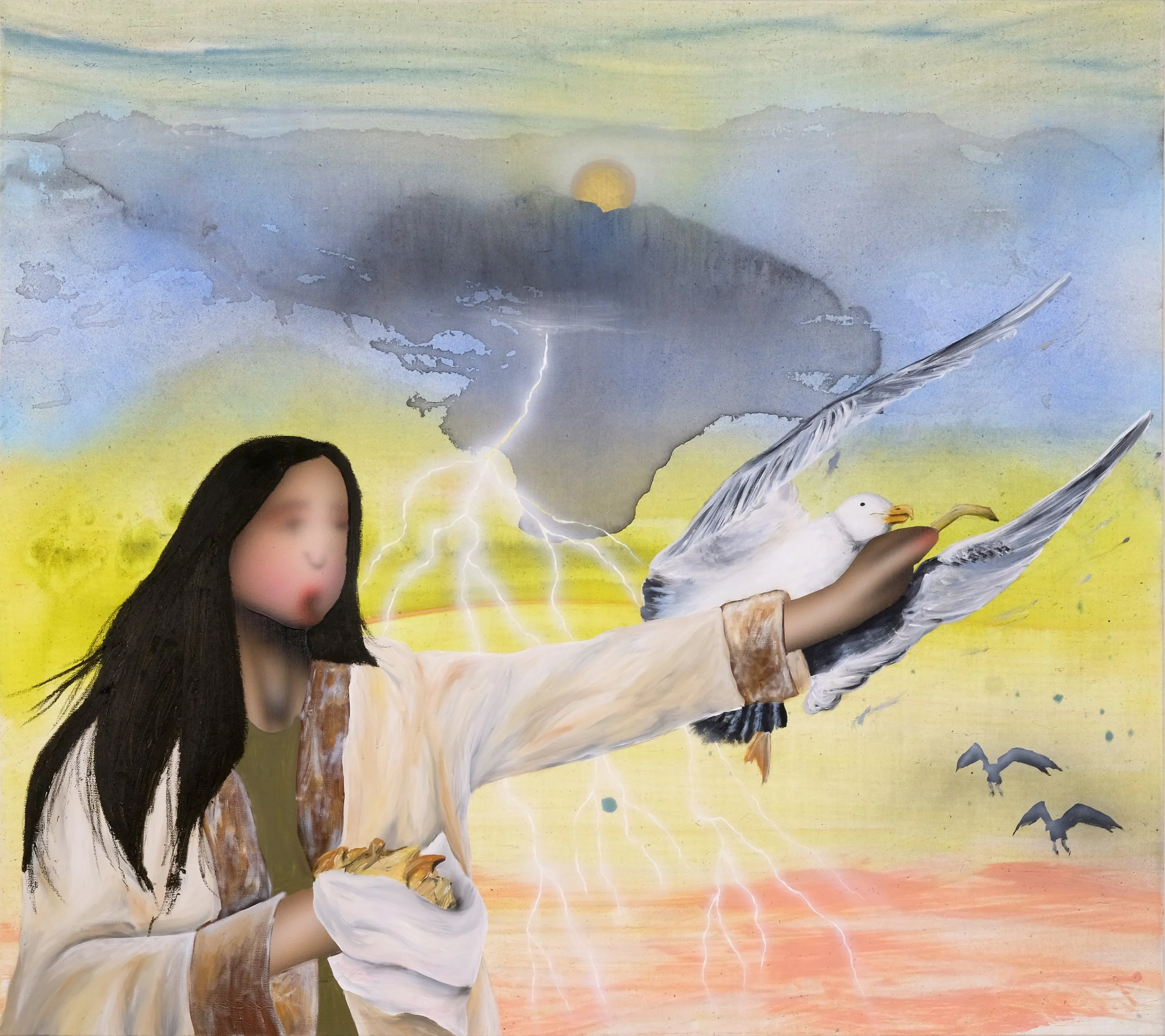
French fries with Mayo, 2026
90 x 80 cm
Acrylic and oil stick on linen
I also avoid clear narrative closure or polished legibility. Faces remain blurred, spatial logic is inconsistent, and the compositions feel suspended between places and times. This creates a visual language that cannot be easily standardized or consumed as a singular message. Instead of producing a uniform “global” image, the works emphasize layered identities and hybrid situations where specificity continues to exist inside broader systems of circulation.
Renaissance influences are visible throughout your work, particularly references to Venetian painting. What role does art history play within your practice?
Art history functions as a structural layer that allows different temporalities to coexist within the same image. By drawing on compositions reminiscent of Venetian Renaissance painting, I use a visual language associated with stability, hierarchy, and idealized space, then introduce contemporary figures that disrupt this coherence. The result is a scene that feels familiar yet slightly displaced, where historical conventions frame present-day situations.
The Venetian Renaissance also serves as a starting point for thinking about cultural exchange. Venice historically operated as a crossroads of trade, migration, and visual influence, which parallels contemporary flows of images and identities. Placing present day subjects within these compositions highlights how cultural forms continue to travel, transform, and accumulate meaning across time.
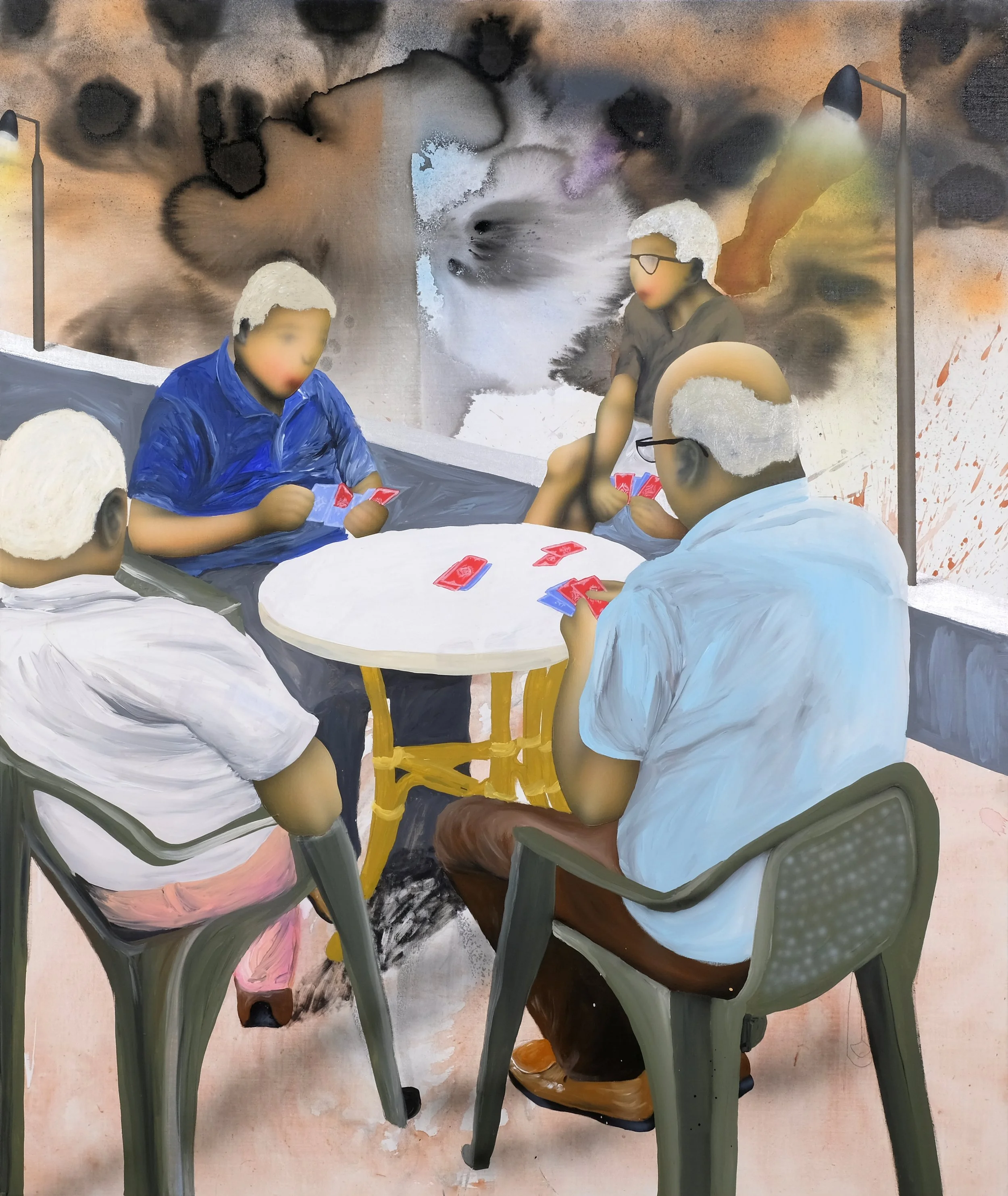
Four Musketeers, 2026
140 x 115 cm
Acrylic and oil stick on linen
Rather than approaching art history nostalgically, I treat it as an active framework. Contemporary clothing, blurred faces, and painterly interruptions destabilize the historical reference and prevent it from becoming a fixed backdrop. This layered approach creates a dialogue where past and present remain visible simultaneously, emphasizing continuity while also exposing the friction between inherited visual models and lived experience.
Earlier works often featured repeated smiles and ambiguous expressions. Your newer paintings feel emotionally more varied and vulnerable. Has your relationship to the figure changed?
In earlier works, the repeated and enigmatic smile functioned almost like a standardized expression a performative mask echoing the uniform emotional language of social media. It suggested a surface-level positivity that flattens individuality and turns identity into something easily readable and endlessly repeatable. The figures appeared present, yet emotionally distant, suspended somewhere between sincerity and performance.
In this new body of work, that uniformity begins to shift. The faces start to register different emotional tones — subtle smiles, fatigue, tenderness, distraction, or ambiguity. This change allows the figures to move away from a single performative expression toward a more fragile and personal emotional range. The ambiguity remains, but it becomes less about repetition and more about openness, where emotions are no longer fixed or easily categorized.
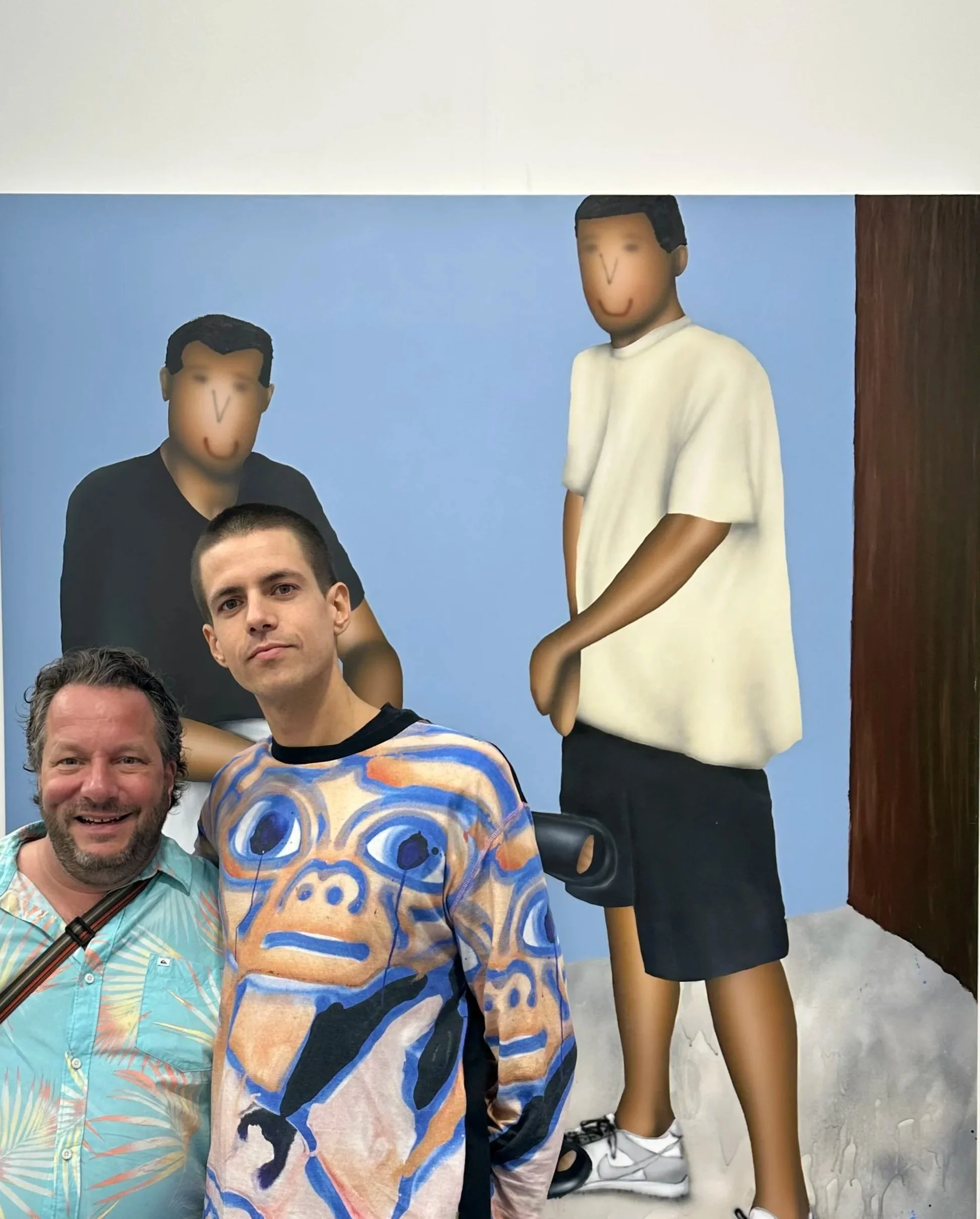
Olivier Varossieau with Evgen Copi Gorisek at Untitled Miami
This transition also reflects a more personal dimension within the work itself. By allowing varied emotional expressions, the paintings introduce vulnerability and resist the idea of a standardized emotional identity. The figures no longer operate as interchangeable types but as individuals navigating layered situations where authenticity appears unstable, negotiated, and continuously evolving.
Looking ahead, what can we expect from your future projects?
Looking beyond Venice, my next major step is my first institutional solo exhibition planned for 2027. It is still early in the process, so I am intentionally leaving space for the project to develop organically. I see it as an opportunity to expand the current exploration of cultural hybridity and shifting identities into a broader spatial context.
Rather than focusing solely on individual paintings, I am increasingly interested in how works can interact across an environment, allowing layered references and narratives to unfold more gradually. The institutional setting offers the possibility to deepen these questions while maintaining the tension between familiarity, displacement, and evolving authenticity.
Interview by Olivier Varossieau || Vroom & Varossieau.