in conversation with plastic jesus
Your work consistently balances sharp cultural critique with strong visual impact. How would you define the core mission of your practice today, and has that evolved over the years?
I spent over 20 years working internationally as a photojournalist. Working for newspapers really hones your ability to create images that convey a message in a single frame. You have one shot to give the viewer an understanding of the story, the human impact,and the backstory. Essentially, that is what makes a great news photograph.
When asked how I categorize my art practice now, I usually reply, “I am still a photojournalist just my medium has changed.” Like a photojournalist, an artist who approaches controversial subjects must balance a very fine line between creating a piece that is engaging and clearly understood.
My work is ultimately about the message. I never set out with a career goal of becoming a successful artist, but journalism and art are fundamentally intertwined.
The evolution of my art has been largely practical. I started as a street artist, creating stenciled works sprayed onto walls under the cover of darkness. But I quickly found making physical pieces far more satisfying. (I’ve never really been a fan of graffiti sprayed directly onto walls something I probably shouldn’t admit as someone who started as a street artist!) Creating a piece, whether installed guerrilla style on the street or ultimately displayed in a collector’s home, can be incredibly fulfilling.
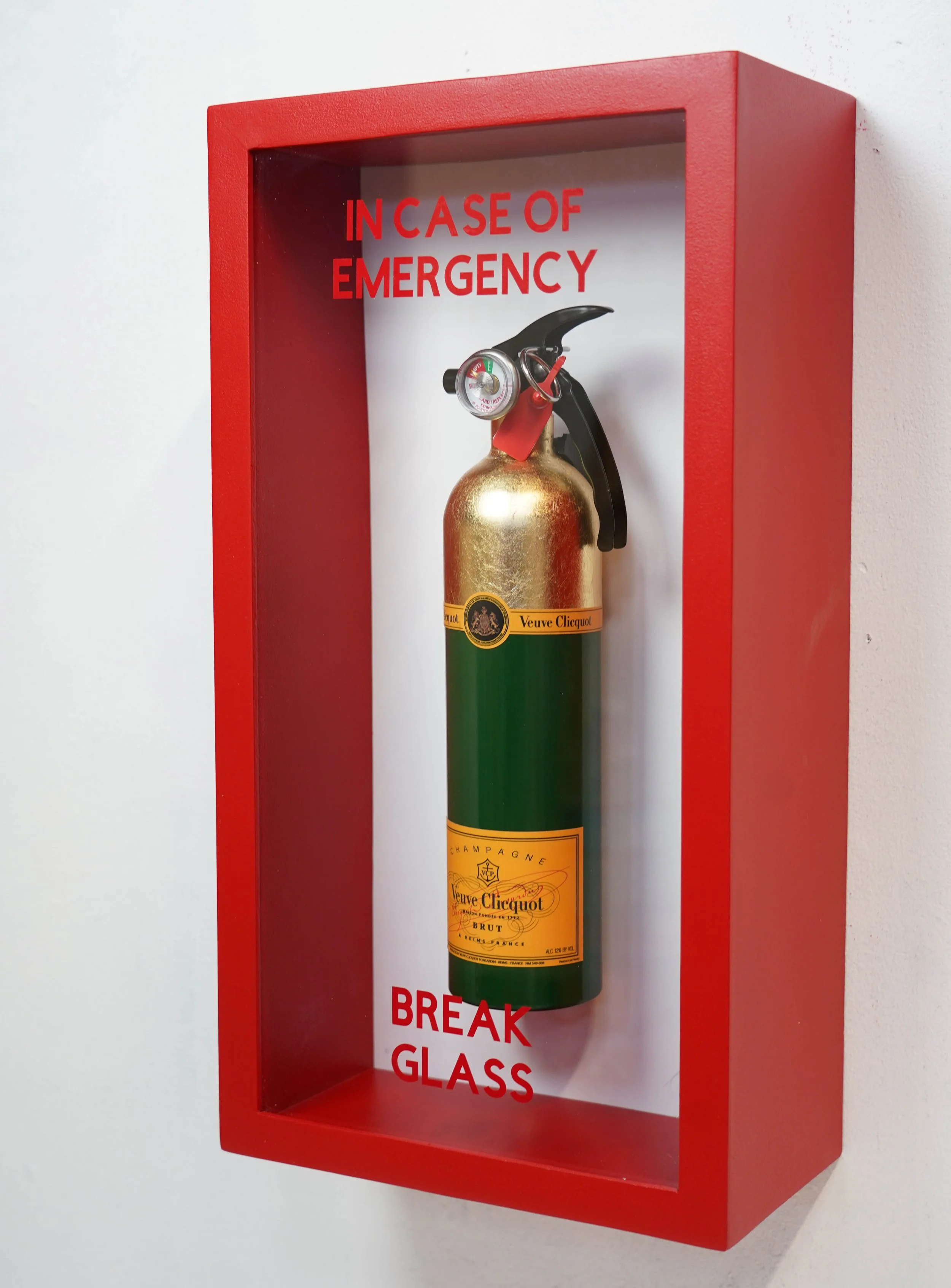
In case of emergency break glass Veuve Cliquot by Plastic Jesus
Many of your recent works feel both urgent and reflective. How do you decide when an idea should become a public intervention versus a limited edition studio piece?
As an artist, you need to have a clear understanding of the purpose of each piece. It may carry a strong message, convey a mood, be beautiful or disturbing, or challenge the audience.
Works that become public interventions are usually intended to express a direct opinion and encourage viewers to question their own position. While these pieces are effective in raising public awareness, most people would not necessarily want to live with a highly controversial work in their home every day. Of course, there are exceptions.
Commercially, I would be mistaken to assume my audience agrees with all my views. Limited edition works allow me to create pieces that are aesthetically compelling and often carry social or cultural meaning — but without the same level of built-in confrontation.
You have built a strong international collector base, with many works selling out quickly. Is it challenging to manage expectations while staying true to your creative process?
I find that many of my collectors understand my background as a photojournalist and recognize the motivations behind my work. I think they know what to expect from me, which allows me to maintain the integrity of my creative process and produce work that resonates without compromise.
Sometimes I joke that I wish I were an artist who simply produced “nice things” or “pretty pictures.” Life would certainly be easier.
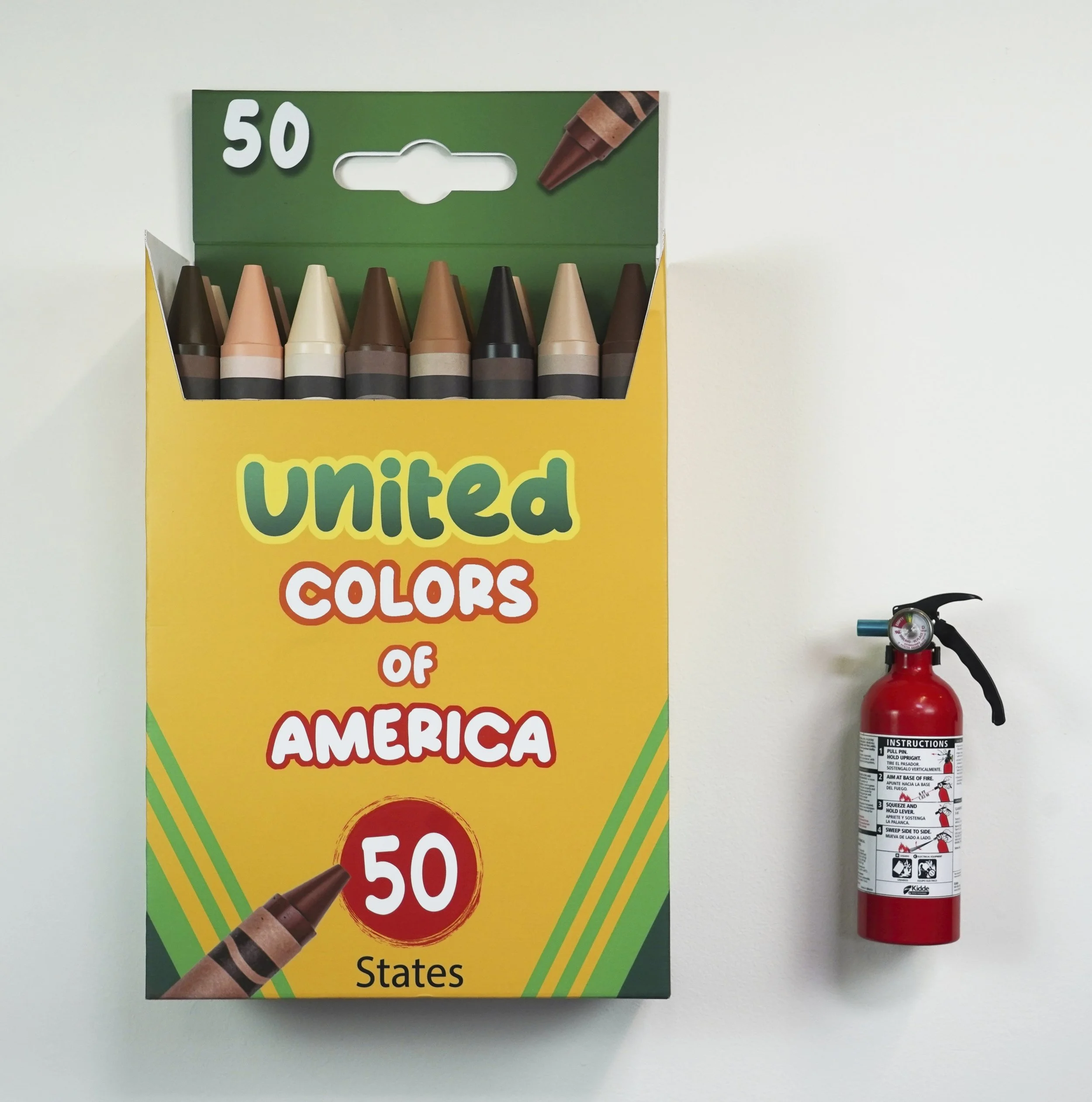
United Colors of America by Plastic Jesus
Do you see “United Colors of America 50 States “ developing into a longterm “evergreen” work within your oeuvre a piece that continues to resonate across generations?
I created this piece in response to the division we are seeing across the United States right now. But it was also inspired by my four year old daughter. She has friends from every corner of the globe and has no prejudice or awareness of race. To her, skin color is simply that a color.
I have used crayons before in my work, including creating a “suicide vest” made of crayons. I think the innocence of children’s toys is a powerful way to encourage adults to reflect on the importance of childlike acceptance and love.
Your daughter has clearly influenced certain recent works. How has fatherhood reshaped your perspective as an artist, both conceptually and emotionally?
Having a child changes everything. It forces you to reassess what you believe is important and possible.
Personally, fatherhood has given me a greater sense of purpose. The legacy I leave is not my physical artwork, but my daughter’s character her compassion, her love for others, and her confidence to challenge things she does not agree with. If I can leave that behind, I will consider myself successful.
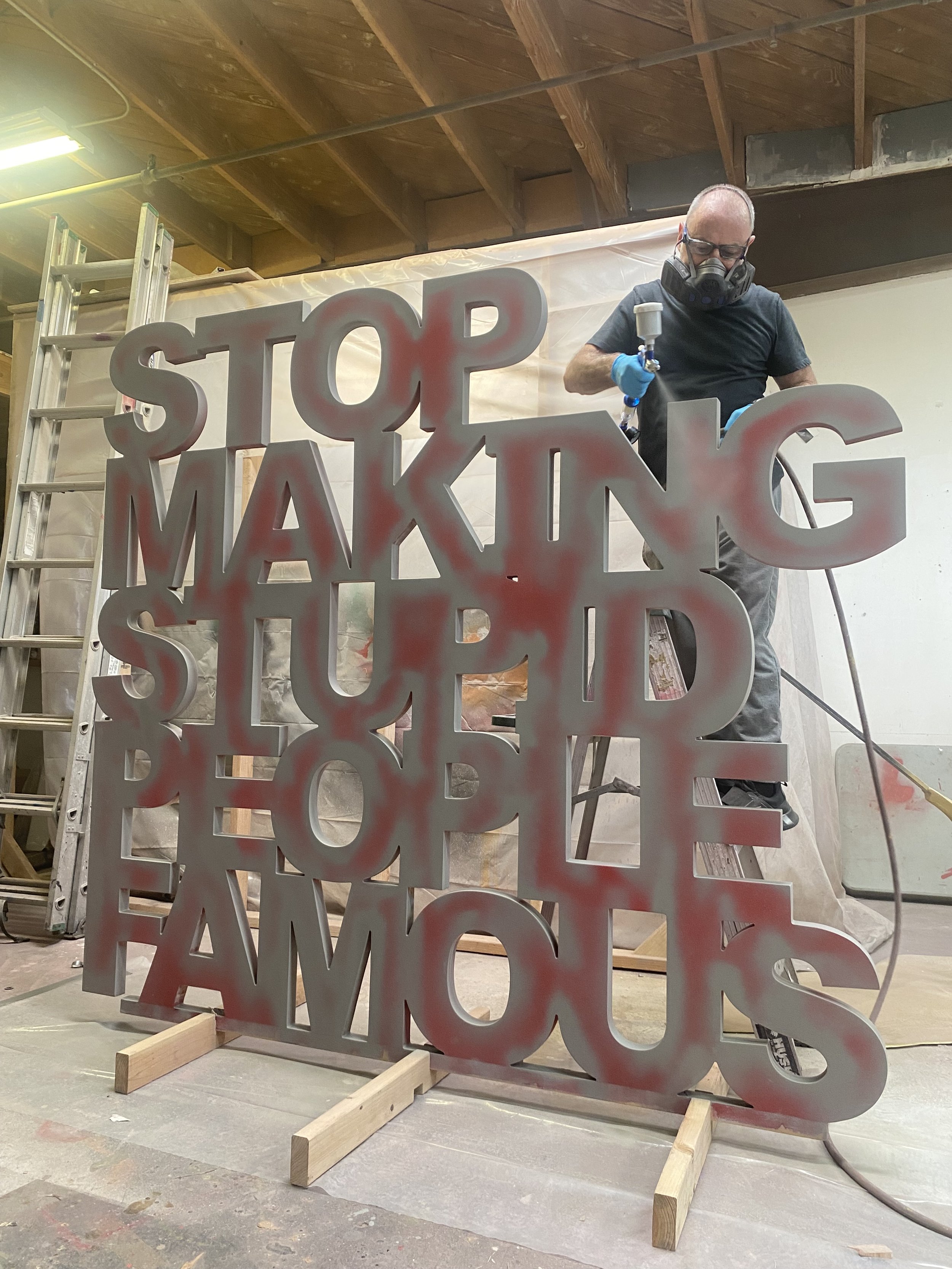
Stop making stupid people famous by Plastic Jesus
The project “Stop Making Stupid People Famous” has become one of your most recognizable statements. Could you elaborate on how that idea originated and how you see its relevance today?
This is probably the work most people associate with me, though it is often misunderstood. The idea originated when I was still working as a photojournalist. I wrote an article for the Huffington Post about the decline of serious news in mainstream media.
Publications once known for reporting global affairs with gravity were increasingly filled with coverage of reality TV personalities and celebrity gossip. The phrase was actually a critique of us the consumers. If we want better news, we should stop making stupid people famous.
In a time marked by global uncertainty and polarization, do you actively seek positive inspiration, or does it emerge naturally within your process?
Both. Some ideas take days, weeks, or even months to develop as I consider all angles and possibilities. Others arrive like a lightning bolt in the shower, driving, or at the park with my daughter.
I love that kind of instant inspiration. If an idea connects with me that powerfully and immediately, it is likely to connect with others in the same way.
You are launching new initiatives such as NKS Creative, expanding into broader visual storytelling and strategic messaging. How do you see this influencing your fine art practice moving forward?
I plan to use my core ability to create powerful messaging in new contexts. I believe every artist must continually challenge themselves, whether internally or externally.
Creating visual messaging for commercial organizations, cultural institutions, or political campaigns will certainly challenge me and expand my creative process.
Are there any upcoming exhibitions, museum collaborations, or public art installations that you can share with us?
Nothing is confirmed just yet. I receive many exhibition requests, but I turn down most of them.
However, one of the world’s largest comic book producers is currently working on a series featuring “Plastic Jesus” alongside the legendary graffiti artist Risk and the talented artist Trew Love. This project will introduce our work to a new audience.
Looking ahead, what themes or materials are you currently exploring for future works? Are there new conceptual territories you are preparing to enter?
I would like to move toward more enduring physical processes, particularly metalwork and welding. This is something I plan to pursue in 2026. Some ideas could be produced in resin, but I feel metal would be a more authentic medium.
I believe it’s important for an artist not to be limited by their existing skills but also not to create work solely based on the tools they have available. A few years ago, my wife asked if I wanted a 3D printer for Christmas. I said no, because the mindset of “Now that I have this equipment, what can I make with it?” feels counterproductive.
An artist should be driven by concept and inspiration first and then find the means to realize the work. As the art world and technology evolve so rapidly, I rule nothing out in terms of medium or inspiration.
interview: Olivier Varossieau