A painting from Endless at GGA Gallery, Miami, opens a conversation about the images we live with, the stories they carry and the way FAILE puts them back together.
A pair of blue heels occupies the foreground. Behind them, a red wall carries a woman’s face, graffiti and handwritten words. Roses and a snake spread across the trousers; torn scraps lie on the tiled floor. Standing on the Edge brings together the glamour of a carefully chosen outfit and the incidental marks of an everyday interior. The figure remains partly hidden. We arrive in the middle of a scene, with enough information to become involved and plenty left to imagine.
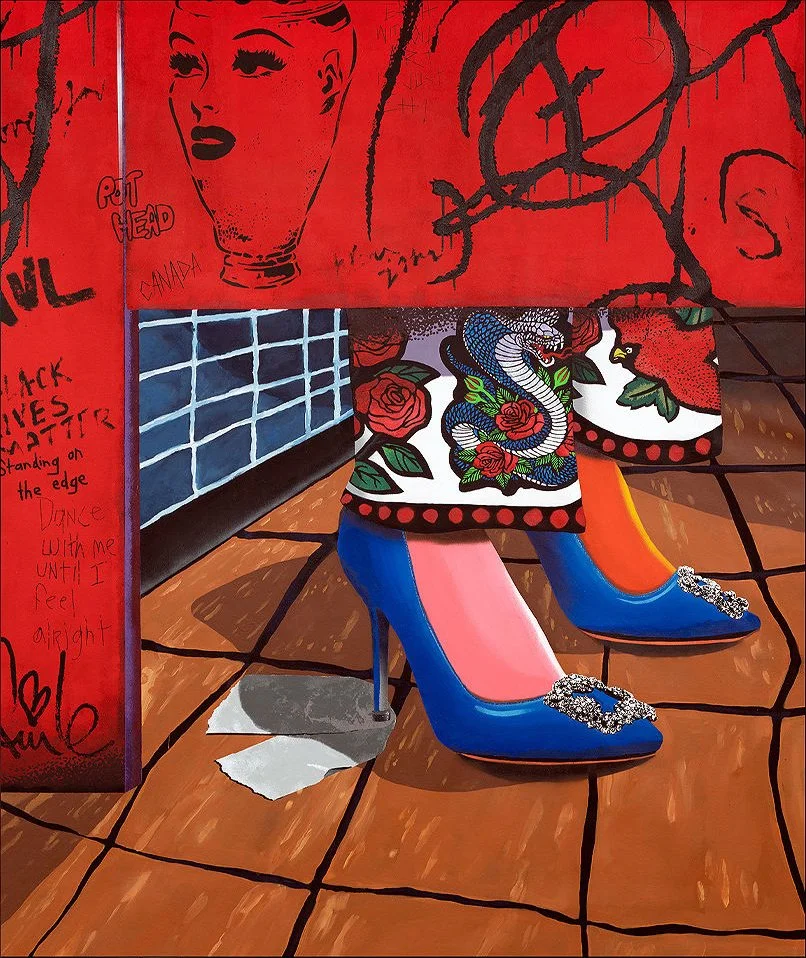
Faile, Standing on the edge
For us, the painting’s appeal lies in that uncertainty. Its colour is immediate, but its story takes longer to unfold. The tiled grid, the sweeping black marks and the decorative fabric draw the eye in different directions. Fashion, tattoo imagery and the language of a marked wall share the same space. Each carries associations, and those associations change as we look from one part of the painting to another.
Behind FAILE are Patrick McNeil and Patrick Miller, friends since their school days in Arizona. Both went on to study graphic design, and their early exchanges of sketchbooks developed into a shared practice. In 1999, they began taking printed images onto the streets of New York. Posters became covered, torn and written over. The city added its own marks, and the artists followed what happened. That encounter with changing surfaces became fundamental to the way they worked. The Great Discontent interview.
Their early collaboration also included Aiko Nakagawa, now known as Lady Aiko, who left in 2006 to pursue her own practice. McNeil and Miller continued as FAILE, developing a body of paintings, prints, sculptures and installations. The name, an anagram of their early project A Life, has stayed with them as the work has moved between the street, the studio and public institutions. Brooklyn Museum biography.
The process behind Endless
The artists’ statement accompanying Endless gives a particularly direct account of their approach. “It’s really about collecting ideas and materials, then just getting into it and finding it in the work,” they explain. For this exhibition, they described meaning emerging through making, cutting, assembling and remixing. They also made clear that the works were not tied together by a single conceptual theme. Images began to suggest stories through the process of bringing them together. FAILE’s exhibition statement.
This matters when looking at Standing on the Edge. Its combination of motifs invites interpretation, while leaving the viewer room to find a personal connection. We might recognise the promise of glamour in the shoes, a moment of vulnerability in the cropped figure, or an intimacy in the writing. These are possible readings of the painting. The artists’ statement encourages that openness: the image takes shape through relationships discovered in the studio.
In their interview with The Great Discontent, Miller described FAILE’s interest in finding meaning among the familiar stories, archetypes and visual cues that surround us. An image can subsequently become a print, painting or sculpture. What begins as a shared act of image-making can develop through several materials and settings. The Great Discontent interview.
Desire, belief and participation
Across their wider practice, FAILE returns to questions of consumer culture, religious traditions and urban life. Their 2015 Brooklyn Museum exhibition, Savage/Sacred Young Minds, brought these concerns into environments visitors could enter and use. Temple drew on religious architecture; the Deluxx Fluxx Arcade, made with BÄST, invited participation through altered arcade games. Pleasure, play and curiosity became ways of engaging with the work and the questions it raised. Brooklyn Museum exhibition announcement.
Standing on the Edge offers a more concentrated encounter. Its visual pleasures give us an entry point, while the partial view keeps the scene unresolved. The painted wall is especially telling: it is both part of the setting and another surface of images within the painting. Looking at it means moving between a depicted place and the marks through which that place has been constructed.
On the pink wall in Miami
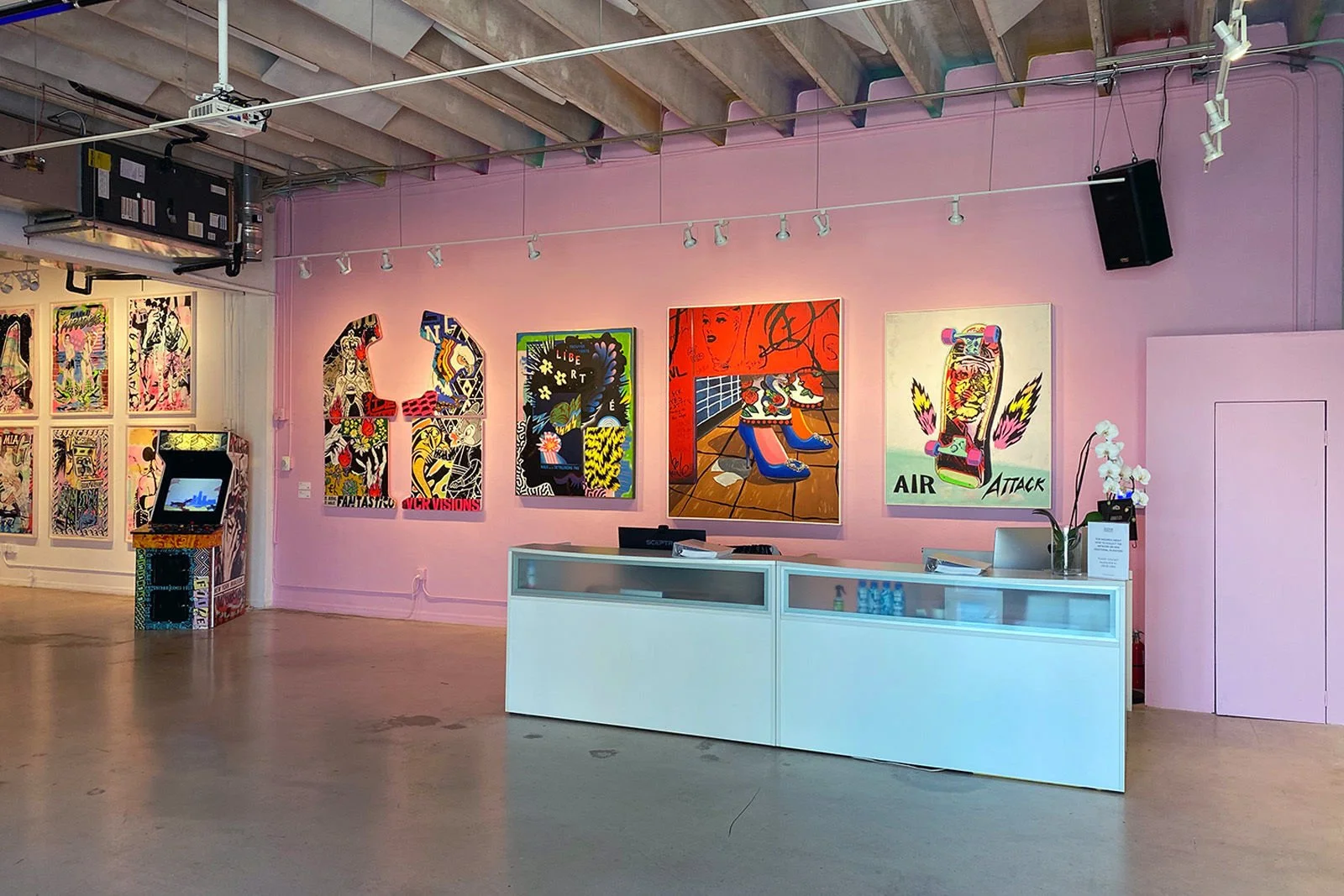
Standing on the Edge was included in Endless at GGA Gallery, within Wynwood Walls, during the winter of 2021–22. FAILE’s archive dates the exhibition from 30 November 2021 to 28 February 2022. FAILE’s exhibition archive.
The installation photographs show the painting above the gallery counter on a pink wall. Nearby, an arcade cabinet and other works extend the visual conversation. Elsewhere, painted boxes rise from patterned plinths, and groups of pictures fill the walls. Seeing the painting in this setting helps explain how an individual FAILE image belongs to a much larger practice: motifs move across surfaces, objects occupy the room, and the viewer makes connections between them.
Seen alone, the painting brings us back to a smaller set of details: a heel touching the floor, words left on a wall, a figure whose face remains outside the picture. These details hold our attention because they suggest a life continuing beyond the frame.
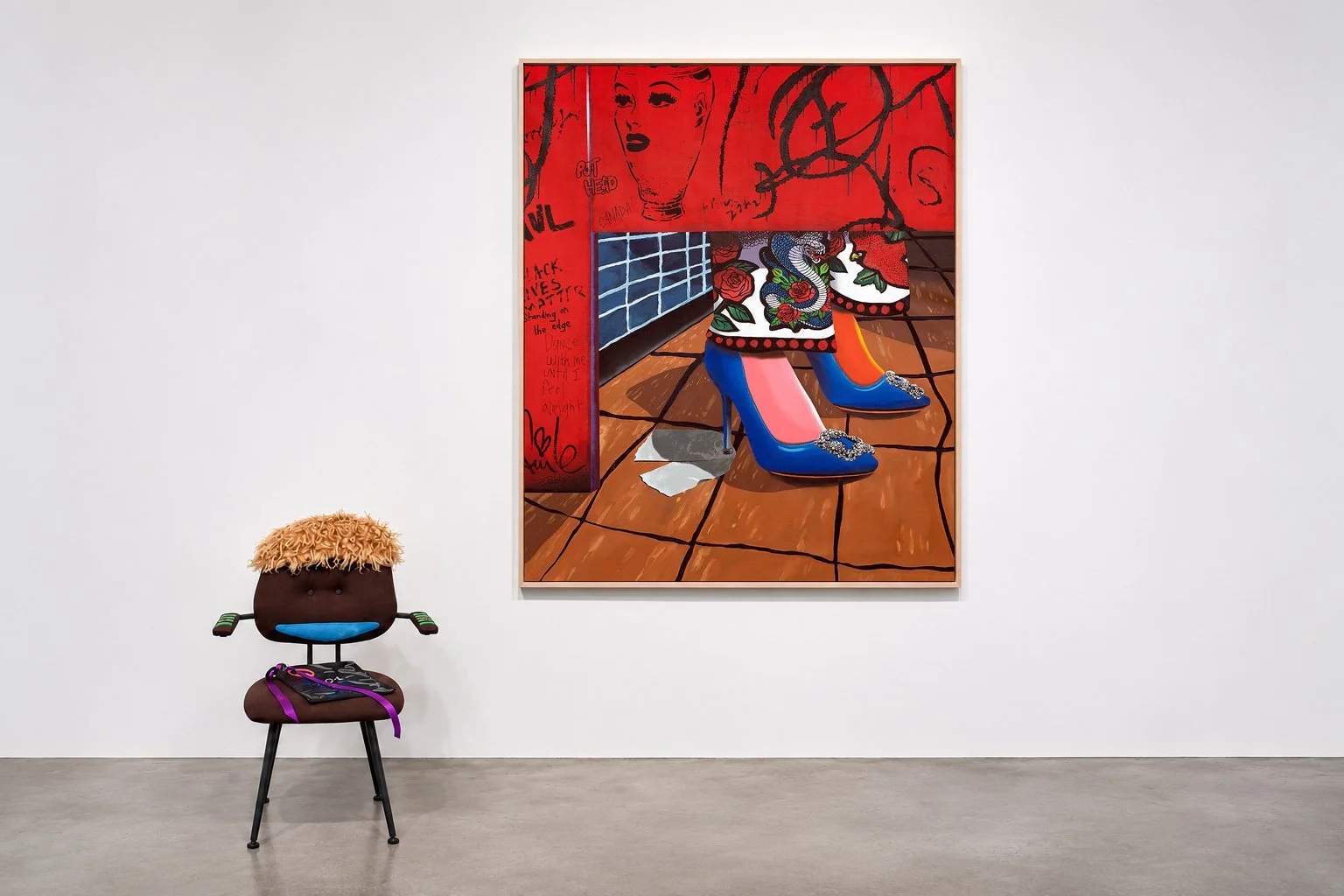
Faile, Standing on the edge with a Character chair by Maarten Baas and Walter van Beirendonck
FAILE
Standing on the Edge
Acrylic, spray paint and ink on canvas, custom frame
72 × 60 in | 182.9 × 152.4 cm
Contact Vroom & Varossieau for further information about this work.
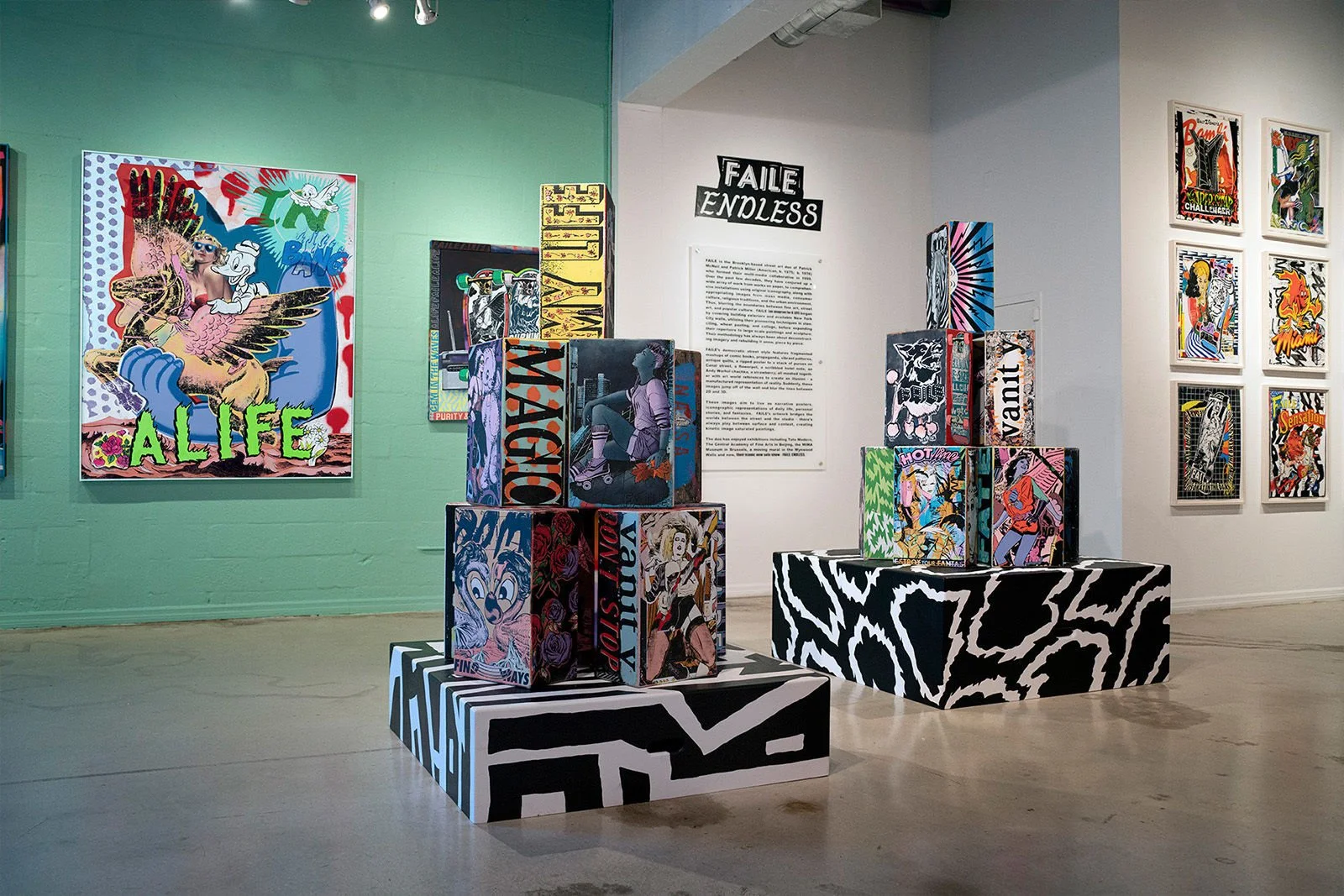
Faile Endless exhibition at GGA Gallery Miami Wynwood
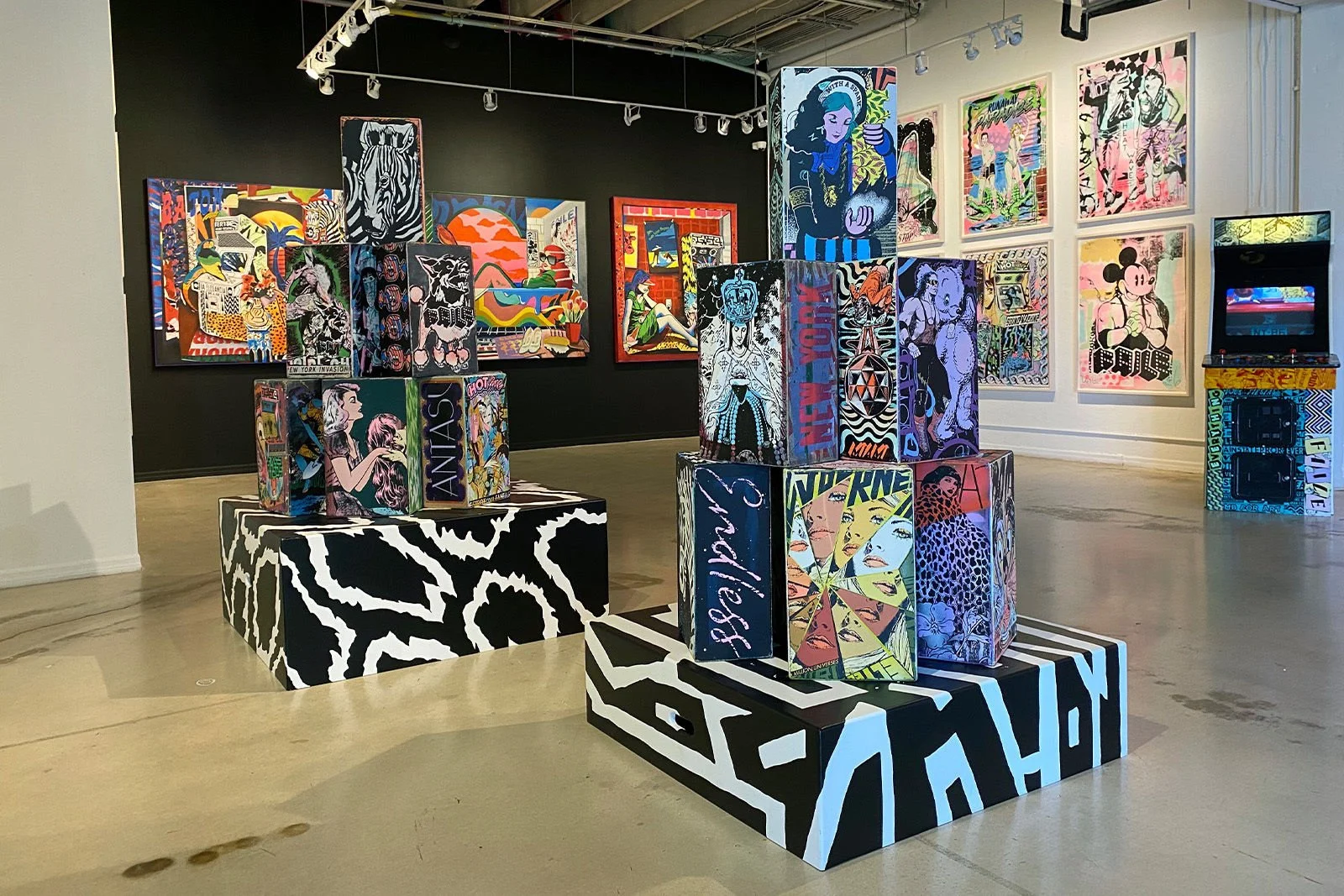
Faile Endless exhibition at GGA Gallery Miami Wynwood
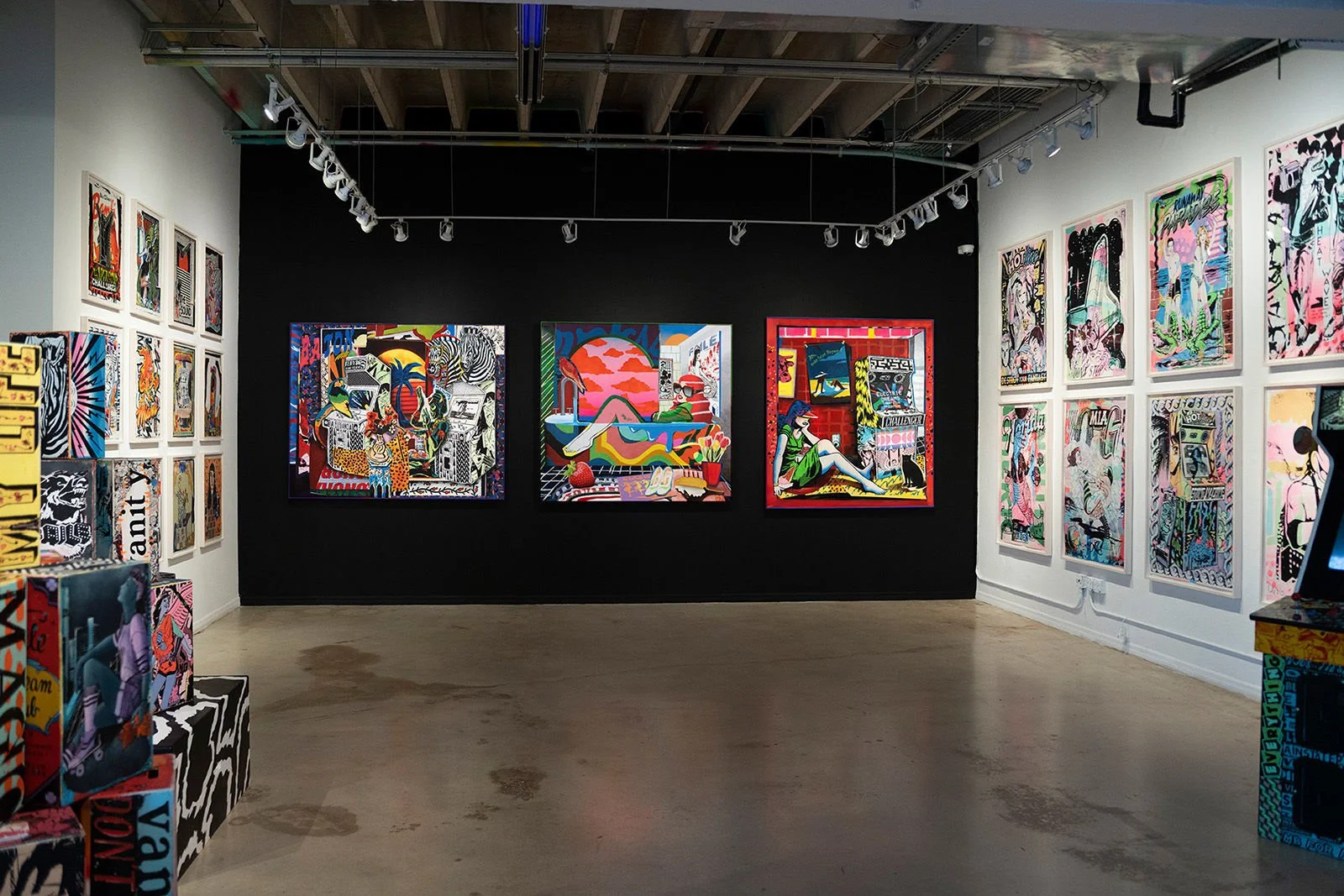
Faile Endless exhibition at GGA Gallery Miami Wynwood